
Your First Group Bike Ride: Pace, Position, and Etiquette
On this page
Quick answer
For a first group bike ride, choose a pace and distance you can sustain with reserve, confirm whether the ride waits for dropped riders, and attend the safety briefing. Hold a predictable line, leave room to react, avoid overlapping wheels, signal changes early, and follow the ride leader's rules. Bring the route and a self-sufficient way home.
Choose the right ride
Group rides use labels such as social, no-drop, intermediate, fast, training, gravel, or race pace, but the same word can mean different speeds and expectations. Ask for typical moving pace, distance, elevation, surface, regroup points, stop policy, and required equipment.
“No-drop” often means the group regroups or has support; it does not always mean every rider stays together continuously. Confirm how long the group waits, whether a sweep rider is present, and what happens after a mechanical problem.
Choose a ride below your maximum ability for the first attempt. Riding close to others adds attention demands even when the speed feels familiar. Weather, wind, hills, and repeated accelerations can make average pace misleading.
Before the start
- Check tires, wheel retention, brakes, drivetrain, lights, and battery systems before leaving home.
- Bring a properly fitted helmet and all equipment required by the organizer and local law.
- Carry water, food, weather layers, identification, essential medicine, and repair supplies you know how to use.
- Load the route offline and note bailout points, transit options, or a pickup contact.
- Tell the leader that it is your first ride with the group and ask where new riders should position themselves.
- Listen to the complete briefing, including calls, formations, regrouping, and emergency procedure.
- Use the restroom and finish adjustments before the departure time.
Ride predictably in the group
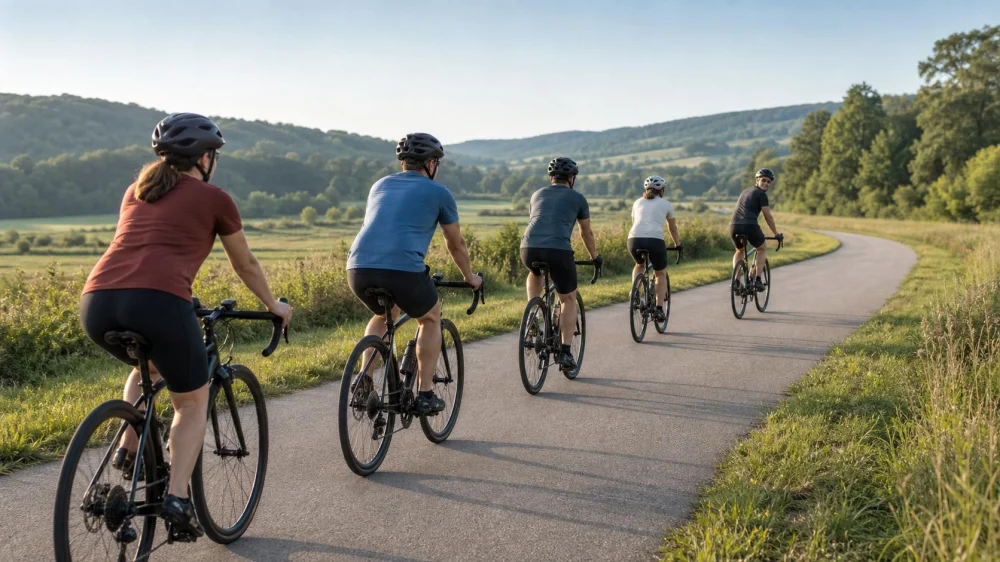
Hold a steady line and pace. Avoid sudden braking, swerving, standing, or moving sideways without checking the space. Look ahead through the group instead of focusing only on the wheel directly in front.
Leave a gap appropriate to speed, surface, skill, visibility, and conditions. Do not overlap your front wheel with the rear wheel beside you; a small lateral movement can remove your space. Increase distance on descents, wet roads, loose surfaces, heavy traffic, and unfamiliar routes.
Match the formation directed by the leader and permitted by local law. Do not ride more riders abreast than conditions allow, block traffic unnecessarily, cross the centerline, or assume the group can ignore signs and signals.
When rotating or passing, make the move only when instructed or clearly safe. Accelerate smoothly enough that riders behind are not forced into a sprint. Do not surge at the top of a hill or after a turn without checking whether the group is intact.
Communicate clearly
Group communication should be early, specific, and calm. Pass forward or backward only the calls your group uses and you can confirm. Typical information may include slowing, stopping, a road hazard, a vehicle, a turn, or a rider off the back, but exact words and gestures vary.
Keep both hands ready to control the bike when conditions require it. A spoken call may be safer than removing a hand in a technical section. Do not shout constantly; too many unverified warnings make important information harder to identify.
Tell nearby riders before reaching for a bottle, removing clothing, or changing position. Save complicated adjustments for a safe stop.
If you fall behind or have a problem
- Call out early. Tell the nearest rider or sweep before a small gap becomes invisible.
- Do not take unsafe risks to reconnect. Obey signals and ride within sight and stopping limits.
- Move fully out of travel lanes. Choose a safe location before stopping for a repair or health issue.
- Use the group procedure. Contact the leader or emergency number supplied at the briefing.
- Assess the bike and rider. Do not continue with unsafe brakes, wheels, steering, injury, or concerning symptoms.
- Use the backup plan. Follow the route, bailout, transit, or pickup arrangement you prepared.
Safety and limitations
Drafting and close formation reduce reaction time and require learned skills. New riders should not imitate race formations without instruction. A qualified cycling coach or experienced ride leader can teach group positioning in a controlled setting.
Stop for injury, chest pressure, severe shortness of breath beyond expected exertion, faintness, confusion, loss of control, or another concerning symptom. Seek emergency help when appropriate. Fitness and medical needs vary; obtain professional guidance when needed.
Traffic laws, trail rules, and cycling formations vary across the United States. Current local law, organizer instructions, and real-time conditions take priority over this general guide.
Sources and evidence notes
The practices reflect broad group-riding safety principles: predictable movement, adequate following space, early communication, legal road position, and a plan for separation. Exact formations and calls are group- and location-specific.
No group label guarantees speed, support, or safety. Verify expectations directly with the organizer.
Frequently asked questions
Where should a beginner ride in the group?
Ask the leader. Many groups place new riders near an experienced sweep or mentor, but the back can also experience pace changes. Use the position assigned for that ride.
Do I have to take a turn at the front?
Not necessarily. Tell the group if you do not intend to pull and follow its method for sitting out a rotation without disrupting others.
What if the pace is too fast?
Say so early and use the regroup or bailout plan. Do not exhaust yourself trying to hide the problem or take traffic risks to catch up.
Can I wear headphones?
Organizer rules and local law vary. Group awareness and communication are essential; follow the briefing and avoid anything that prevents you from hearing warnings or traffic.
Should I call every small road crack?
Prioritize meaningful hazards that affect the group's line and use the group's established calls. Avoid making sudden swerves while pointing.
Next steps
Ask the organizer for actual pace, terrain, no-drop meaning, equipment, and formation rules. Prepare the bike, load the route, and introduce yourself to the leader. During the ride, hold a predictable line, leave reaction space, communicate early, and use your backup plan before fatigue leads to unsafe choices.
 Fox River Sports4.0 (40 reviews)
 Storrs Center Cycle4.0 (81 reviews)
 UrbanVolt Cycles Shop0.0 (0 reviews)
 Berkshire Bike and Board Hudson4.0 (14 reviews)
 In Gear Cycling & Fitness4.0 (92 reviews)
 Jenson USA4.0 (252 reviews)
 How to Teach Kids to Ride a Bike: A Step-by-Step Guide for Parents
 Tips for Riding on Busy City Streets: Smart Strategies for Urban Cyclists
 Best US National Parks for Mountain Biking: Ride Epic Trails Across America
 Best Aero Helmets for Time Trials and Racing
 How to Clean and Lubricate Your Bike Chain Like a Pro
 10 Must-Have Items for Long-Distance Cycling Trips