
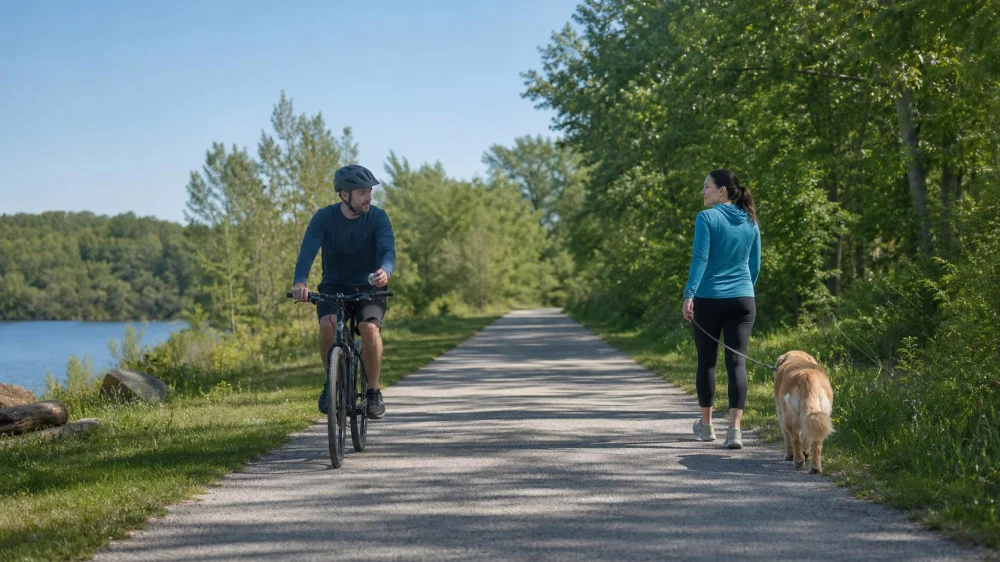
Bike Bell Etiquette: Alert Others Without Startling Them
Table of contents
Quick answer
Use a bike bell as an early, courteous notice—not a command to move. Slow down first, ring once or twice from enough distance to be heard, and add a calm “passing on your left” when useful. Wait for a sign that the person knows you are there, then pass only when the path is clear and wide enough. Be ready to stop if anyone moves unpredictably.
Know where a bell helps
A bell is most useful on shared-use paths, greenways, low-speed neighborhood routes, and approaches where walkers or slower riders may not hear a bicycle. It can also announce your presence near a blind bend when local rules and conditions allow. Some places require a bell or audible device; others regulate sidewalk riding or passing.
Read trailhead signs and local law. A bell does not grant right of way or permit unsafe speed. Yield rules, centerlines, no-passing zones, pedestrian priority, stop controls, and posted speed limits still apply.
Signal early, not loudly
Begin by reducing speed. Ring while you still have room to observe and stop, rather than when your front wheel is beside the person. One clear ring often works better than repeated urgent ringing. On a noisy path, pair the bell with a friendly voice at normal volume.
Distance depends on closing speed, ambient noise, path width, and the other user's movement. The goal is time to understand the signal without feeling chased. If you are moving too fast to wait for a response, you are moving too fast for that pass.
Wait for a response
Look for a head turn, hand gesture, steady line, shortened leash, or other sign of awareness. Do not assume headphones mean the person heard you, and do not assume no headphones means they did. Hearing differences, wind, conversation, mobility needs, and surprise can affect response.
If there is no acknowledgment, slow to walking speed or stop. Call out calmly from farther back. Never escalate to shouting, an air horn, or an extremely close pass merely because someone did not react.
Make the pass with space
Check ahead and behind, signal if changing line, and pass only where sight distance and width are adequate. Obey centerlines and keep a generous lateral gap. Reduce the speed difference so a stumble or sideways step does not become a collision.
Say “thank you” as you pass, then wait until fully clear before returning to your line. Do not cut sharply in front of a pedestrian or slower rider. On a narrow bridge, busy segment, blind corner, hill crest, or opposing-traffic pinch point, wait.
Adapt around children, dogs, and groups
Children can change direction suddenly. Slow well before reaching them and wait for an adult's acknowledgment. Around dogs, give extra room for the leash, avoid ringing at very close range, and never ride between a handler and animal. A retractable leash may be hard to see.
For groups spread across the path, signal early and allow time for them to organize. Do not thread between companions. Horses require site-specific etiquette; stop or speak to the rider from a distance and follow their direction rather than relying on a bell.
Know what a bell cannot do
A bell cannot overcome a blind curve, excessive speed, insufficient width, ice, loose gravel, a dog crossing the lane, or opposing traffic. It also cannot replace lights, brakes, lane position, hand signals, or verbal communication. Never use it to pressure someone off the path.
At road intersections and driveways, do not depend on a bell to make drivers see you. Slow, scan, follow traffic controls, and make a visibility-based decision. NHTSA emphasizes predictable riding and careful interaction with pedestrians.
Set up and test the bell
Mount the bell where you can operate it without releasing your normal grip or interfering with brakes, shifters, cables, or accessories. Test it while parked. The sound should be clear, and the striker should return freely. Tighten the mount according to instructions so it does not rotate into a control.
Practice ringing once while maintaining a straight line in an empty, traffic-free area. If the device is too quiet for typical conditions, poorly positioned, or unreliable in rain, replace or reposition it. Do not choose a painfully loud device for routine close-range use.
Passing checklist
- Slow before signaling.
- Check that passing is legal and the lane is clear.
- Ring early once or twice.
- Add a calm side-specific voice cue if useful.
- Wait for awareness.
- Leave generous lateral space.
- Pass with a small speed difference.
- Return to your line only after fully clear.
- Be ready to stop throughout.
Limitations and local rules
This article provides general riding guidance, not legal advice. Bell requirements, passing rules, sidewalk access, speed limits, and right-of-way laws vary. Follow posted signs and local law. Surface, traffic, visibility, rider skill, and other users' needs may require waiting rather than passing.
Frequently asked questions
How many times should I ring?
Usually one or two early rings are enough. Repeated ringing can sound aggressive. If there is no response, slow further and use a calm voice.
Should I always say “on your left”?
It can help, but some people turn toward the word “left.” Ring early, slow down, and watch the response rather than treating the phrase as a guarantee.
Can I pass if the person does not acknowledge me?
Only when you can do so with ample space at very low relative speed and remain ready to stop. On a narrow or uncertain path, wait.
Is a louder horn safer?
Not for routine shared-path passing. A very loud sound can startle people into your line. Use a conventional bell and speed control.
Do pedestrians have to move?
A bell is a notice, not an order. Yield and passing duties depend on local rules, and cyclists should pass pedestrians with care.
Sources and evidence
- National Highway Traffic Safety Administration: Bicycle Safety — advises predictable riding and announcing a pedestrian pass with a voice cue or bell.
- Federal Highway Administration: Shared-Use Path Operations — examines passing interactions among cyclists, pedestrians, and other path users.
Next steps
Test your bell while parked and move it if you must release the brake to reach it. On the next path ride, practice a simple sequence: slow, ring early, wait, pass wide, and thank the person. If the route is too narrow or busy for that sequence, stay behind until a safer passing point appears.

 RecumbentPDX4.0 (146 reviews)
 Zone 3 Multisport LLC4.0 (46 reviews)
 SalmonBerry Cycle5.0 (1 reviews)
 Firmstrong4.0 (7 reviews)
 Vancouver Cyclery4.0 (296 reviews)
 RideTHISbike4.0 (66 reviews)
 How to Teach Kids to Ride a Bike: A Step-by-Step Guide for Parents
 Tips for Riding on Busy City Streets: Smart Strategies for Urban Cyclists
 Best US National Parks for Mountain Biking: Ride Epic Trails Across America
 Best Aero Helmets for Time Trials and Racing
 How to Clean and Lubricate Your Bike Chain Like a Pro
 10 Must-Have Items for Long-Distance Cycling Trips