
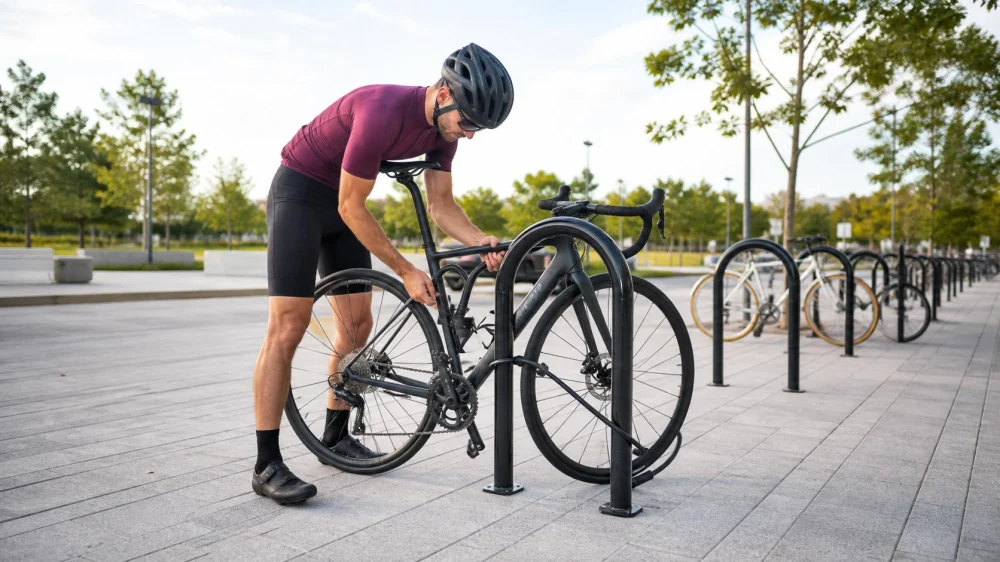
How to Lock a Bicycle and Protect Its Removable Parts
On this page
Quick answer
Park in a visible, permitted area and verify that the rack is firmly anchored before locking. Pass a high-quality lock through the bicycle frame and a wheel to the rack, then secure the other wheel and quick-release parts with a second lock or cable appropriate to the risk. Remove lights, bags, batteries, and accessories when practical. No lock guarantees security, so reduce time and exposure.
Choose the parking location
Use a designated rack that lets the bicycle frame contact a solid, closed structure. Check that bolts, rails, and the rack itself cannot be lifted, cut apart easily, or slipped out of the lock. Avoid trees, railings, signs, accessible routes, emergency equipment, and private property where bicycle attachment is prohibited.
- Prefer good visibility and normal foot traffic without blocking pedestrians.
- Use lighting and monitored areas where available, but do not assume cameras prevent theft.
- Avoid leaving the bicycle overnight when secure indoor storage is possible.
- Park so wheels and frame do not extend into a travel lane.
Lock frame and wheels
- Position the bike close. Reduce the open space between frame, rack, and lock.
- Capture the frame. A lock around only a wheel can leave the rest of the bicycle unsecured.
- Include a wheel. Route the primary lock through the frame and one wheel when geometry allows.
- Secure the second wheel. Use a second lock or a cable with the primary lock, recognizing that thin cables offer less resistance.
- Keep the lock off the ground. Position it so leverage and impact are more difficult and the keyway remains usable.
- Test the result. Pull the bike and rack gently to confirm the lock closed and no component can slip free.
Protect removable components
Quick-release wheels and seatposts require extra attention. Replace quick releases with security hardware when appropriate, or pass a suitable secondary system through them. Take detachable lights, computer, pump, tool bag, panniers, helmet, and other accessories with you.
For an e-bike, follow battery-maker guidance. Remove the battery if designed for routine removal and practical to carry, or engage its integrated lock as instructed. A battery lock is not necessarily equivalent to securing the bike frame.
Departure checklist
- Parking is permitted and does not block access.
- Rack is closed, solid, and anchored.
- Primary lock captures frame, rack, and ideally one wheel.
- Second wheel and quick-release components are secured.
- Lock is fully closed and cannot slide over the rack.
- Accessories and valuable removable items are taken with you.
- Bike serial number, description, and current photos are stored privately.
Limitations and important notes
Every lock can be defeated with enough time and tools. Match security to the bicycle’s value, parking duration, location, and local patterns. Manufacturer ratings and independent testing can help compare products, but they are not guarantees.
Register the bicycle where an appropriate program exists and keep proof of ownership. If theft occurs, prioritize personal safety, document the location, and report through the relevant police, property, insurer, or registration process. Do not confront a suspected thief.
Sources and evidence notes
This layered method reflects common bicycle-security guidance: secure the frame to an immovable rack, reduce leverage space, protect wheels and removable parts, choose visible permitted parking, and retain identifying records. Lock instructions and local rules control details.
Frequently asked questions
Is one U-lock enough?
It may secure the frame and one wheel, but the other wheel and accessories can remain exposed. Risk and component design determine whether a second device is appropriate.
Can I lock only the front wheel?
No. The frame can be separated from the wheel. Always capture the frame and rack with the primary security method.
Are cable locks useful?
They can add component security, but many provide less resistance than strong primary locks. Use them according to their rating and risk.
Should I hide the bicycle’s serial number?
Store it privately with photos and proof of ownership. Do not publish sensitive registration details unnecessarily.
Next steps
Record the bicycle’s serial number and photos, select locks that fit its frame and wheels, and practice the route before a real trip. At each stop, verify the rack, capture the frame, secure both wheels and removable parts, and keep parking time reasonable.


 Bicycle One4.0 (227 reviews)
 RIZE Bikes | Distribution Centre4.0 (46 reviews)
 29ers Bike shop4.0 (51 reviews)
 Fly E-Bike Columbus Ave4.0 (95 reviews)
 WeeBikeShop Inc5.0 (20 reviews)
 Eazy E. Bikez4.0 (184 reviews)
 How to Teach Kids to Ride a Bike: A Step-by-Step Guide for Parents
 Tips for Riding on Busy City Streets: Smart Strategies for Urban Cyclists
 Best US National Parks for Mountain Biking: Ride Epic Trails Across America
 Best Aero Helmets for Time Trials and Racing
 How to Clean and Lubricate Your Bike Chain Like a Pro
 10 Must-Have Items for Long-Distance Cycling Trips