
E-Bike Battery Transport: Heat, Damage, and Charging Checks
On this page
- Quick answer
- Treat the battery as part of a system
- Inspect before every trip
- Pack and secure it correctly
- Manage heat, cold, and moisture
- Charge at the destination
- Recognize warning signs
- Check recalls and end-of-life options
- Limitations and important notes
- Sources and evidence notes
- Frequently asked questions
- Next steps
Quick answer
Before transporting an e-bike battery, use the bike manufacturer’s instructions to decide whether it stays locked on the bike or travels in an approved protective setup. Inspect for impact, swelling, cracks, heat, odor, water entry, damaged contacts, or loose mounting. Protect terminals, secure the battery against movement, avoid hot vehicles, and do not transport or charge a questionable pack. At the destination, use only the charger approved for that exact battery system and stay present while charging.
This guide covers general ground transport for personal e-bikes in the United States. Battery chemistry, size, design, vehicle carriage, public transit, rail, ferry, shipping, and airline rules differ. Follow the current manufacturer, carrier, property, fire-code, and legal requirements for the exact trip.
Treat the battery as part of a system
An e-bike electrical system includes the battery, battery-management electronics, charger, wiring, controls, and drive components designed to work together. A connector that fits does not prove that a charger, adapter, or replacement battery is electrically compatible.
Record the bike model, battery model and serial number, charger model, voltage and other required specifications, key information, and purchase documents. Save the manufacturer’s current transport, charging, storage, and emergency instructions offline.
Before using a replacement or second battery, confirm in writing that the bike manufacturer or qualified system provider approves it for the exact model. A custom conversion needs documentation for the complete battery, motor, controller, and charger combination—not just a cell brand.
Inspect before every trip
Switch the e-bike off, disconnect charging equipment, and inspect in a dry area away from flames, sparks, heaters, and combustible clutter. Do not open the battery housing.
Stop and seek qualified guidance when you find:
- swelling, bulging, cracking, splitting, or case deformation;
- impact marks from a crash or drop;
- melted plastic, scorch marks, unusual heat, smoke, or odor;
- water entry, heavy corrosion, or contaminated contacts;
- loose, bent, recessed, or burned terminals;
- damaged mounting rails, lock, latch, handle, cable, or connector;
- unexpected shutdowns, charging errors, rapid range change, or another new behavior; or
- a recall, stop-use notice, or warning affecting the product.
Do not “test” a questionable pack by charging it, riding around the block, squeezing the case, shorting contacts, or opening it. Battery damage can exist even when the exterior seems mostly normal after a hard impact.
Pack and secure it correctly
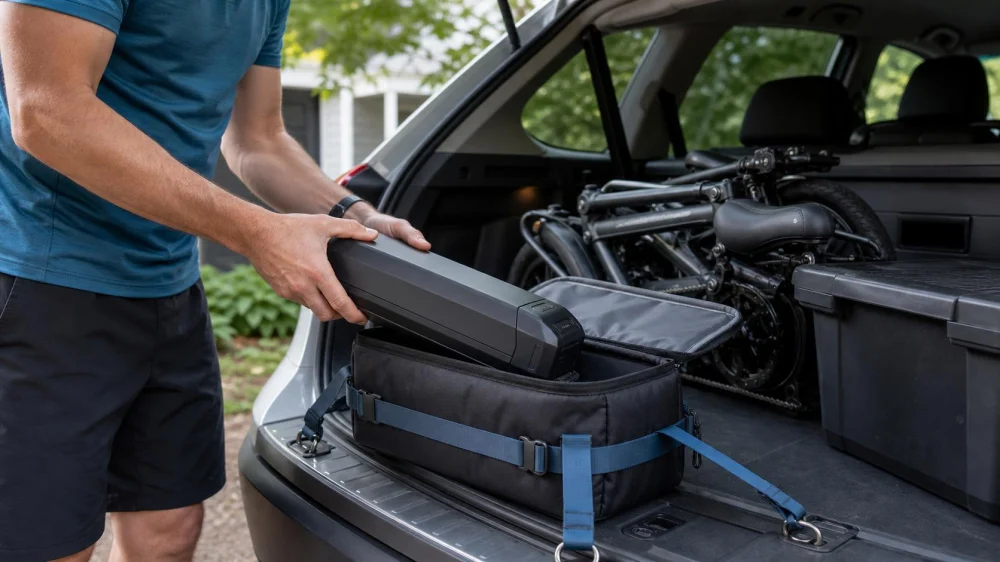
First check whether the manufacturer directs you to remove the battery for vehicle transport. Some bike racks have battery-weight limits or require removal; some battery mounts are not designed for highway wind, road spray, or repeated vibration.
When removal is required:
- Switch off the system and remove the battery using the manual’s sequence.
- Use the manufacturer’s terminal cap, contact cover, or approved protective method.
- Place the battery in an approved case or padded compartment that prevents impact and movement.
- Keep metal tools, loose hardware, keys, and conductive objects away from terminals.
- Secure the case so it cannot slide, fall, be crushed, or become a projectile in a sudden stop.
- Keep the battery accessible enough to remove the entire setup in an emergency without burying it under heavy gear.
Do not carry the battery by a charging cable or unsupported connector. Do not tape over cooling openings or modify the case. If you use a bike rack, verify total bike weight, per-bike weight, wheelbase, tire width, frame contact, and the effect of battery removal on balance.
For buses, trains, rideshare vehicles, ferries, or other carriers, get current permission before arrival. E-bike size acceptance does not automatically mean the removable lithium-ion battery is accepted.
Manage heat, cold, and moisture
Do not leave an e-bike battery in a parked vehicle or direct sun. Vehicle interiors can become dangerously hot, and high temperature can damage cells and increase fire risk. Drive directly, unload promptly, and store within the temperature range in the manual.
Cold can temporarily reduce performance. Do not force high power from a battery that the manufacturer says is too cold, and do not charge it until it returns to the permitted charging temperature. Let temperature equalize in a dry, appropriate location according to the manual.
Protect the battery from rain, road spray, condensation, immersion, and wet gear. A water-resistance rating is not permission to submerge, pressure-wash, or transport with exposed contacts. If water intrusion is possible, stop using and charging it and contact the manufacturer or qualified service provider.
Charge at the destination
Confirm the property permits e-bike charging and provides an appropriate outlet and location. Use only the charger supplied with or specifically approved for the exact battery. The U.S. Consumer Product Safety Commission warns against “universal” micromobility chargers unless they have been tested and approved to work safely with the device.
A safer charging checklist:
- Inspect the battery, charger, cord, connector, and outlet before connection.
- Place the battery and charger as directed on a stable, dry surface away from exits and combustible materials.
- Keep cooling openings unobstructed.
- Connect and disconnect in the manufacturer’s specified order.
- Remain present and awake while charging.
- Stop when charging is complete or when the instructions say to disconnect.
- Do not use an extension cord, power strip, timer, adapter, generator, inverter, or solar setup unless every component is explicitly approved for that use.
Do not charge in a sleeping area, exit path, stairwell, or other location where a fire could trap people. Never charge a hot, wet, frozen, dropped, swollen, recalled, or otherwise suspicious battery.
Recognize warning signs
Stop charging or riding if the battery becomes unusually hot, swells, hisses, cracks, leaks, smokes, smells unusual, sparks, or behaves differently. Do not touch, move, or cover a battery that is smoking, venting, or on fire.
Warn others, leave the area, close a door behind you if safe, and call 911 from a safe location. Lithium-ion battery fires can intensify rapidly and may reignite. Follow fire-department instructions and do not reenter for the bike or gear.
A battery that has cooled after an incident is not automatically safe. Keep people away and obtain instructions from emergency responders, the manufacturer, and the appropriate hazardous-materials or recycling authority.
Check recalls and end-of-life options
Before a trip and before buying a used battery, search the CPSC recall database and manufacturer notices using model and serial information. Follow stop-use and remedy instructions exactly; do not sell, donate, transport, charge, or repurpose a recalled pack contrary to the notice.
Do not place an e-bike battery in household trash, curbside recycling, or an ordinary retail battery box unless the program explicitly accepts that type and condition. Large or damaged lithium-ion batteries need specialized handling. Contact the manufacturer, authorized dealer, local household hazardous-waste program, or approved e-bike battery recycling program.
Do not ship a damaged battery or mail it back without the carrier and manufacturer’s hazardous-material instructions. Shipping rules can be more restrictive than carrying a safe battery in a personal vehicle.
Limitations and important notes
- A visual check cannot verify cell condition, battery-management function, or internal impact damage.
- Certification marks should be verified through the certifying organization; a printed logo alone can be misused.
- Battery percentage is not a measure of physical safety.
- A fire-resistant bag or box does not make a damaged battery safe to transport or charge.
- Airline, passenger rail, ferry, and shipping restrictions can prohibit batteries that are acceptable for an ordinary local ride.
Do not repair, rebuild, re-cell, open, or modify a battery without qualified authorization and appropriate facilities. When in doubt after damage or abnormal behavior, keep it out of service and ask the original manufacturer or an authorized e-bike technician.
Sources and evidence notes
CPSC guidance emphasizes using the charger supplied with or approved for the exact micromobility device and warns that a physically compatible “universal” charger can still create a fire hazard. UL Solutions also treats the e-bike, battery, and charger as an evaluated electrical system and recommends authorized inspection after battery damage.
Transport and storage details remain product-specific. Use the manual and carrier rules for the exact battery and trip.
Frequently asked questions
Should I remove the battery before putting an e-bike on a car rack?
Follow the bike, battery, and rack manufacturers. Removal is often required for weight, weather, or retention reasons, but the removed battery must then be protected and secured correctly.
Can I use a charger with the same plug?
Not unless the battery or bike manufacturer specifically approves that charger for the exact system. Connector fit does not verify voltage, current, communication, polarity, or charging profile.
Can I charge the battery in a hotel room?
Ask the property and follow fire rules plus manufacturer instructions. Do not charge in a sleeping area or exit path, and remain present. If an appropriate permitted location is unavailable, do not improvise.
What if the battery was dropped but still works?
Stop using and charging it until the manufacturer or authorized service provider advises on inspection. Normal operation does not rule out internal damage.
Can I leave the battery in the car during lunch?
No. A parked vehicle can heat rapidly. Unload and store the battery in an approved location within its temperature limits, or redesign the trip.
Next steps
Save the exact battery and charger information, read the manufacturer’s transport instructions, inspect the pack, and decide whether it stays mounted or travels in an approved protective setup. Secure it against impact and heat, verify carrier rules, and plan an authorized charging location. If damage, unusual heat, odor, swelling, or a recall appears, stop and obtain qualified guidance.





 Beach E-Bikes Rentals & Sales4.0 (32 reviews)
 Trek Bicycle Murfreesboro5.0 (289 reviews)
 Albabici4.0 (12 reviews)
 Pops Bike Shop4.0 (143 reviews)
 PEV Connection, LLC5.0 (31 reviews)
 Trek Bicycle Allentown4.0 (553 reviews)
 How to Teach Kids to Ride a Bike: A Step-by-Step Guide for Parents
 Tips for Riding on Busy City Streets: Smart Strategies for Urban Cyclists
 Best US National Parks for Mountain Biking: Ride Epic Trails Across America
 Best Aero Helmets for Time Trials and Racing
 How to Clean and Lubricate Your Bike Chain Like a Pro
 10 Must-Have Items for Long-Distance Cycling Trips