
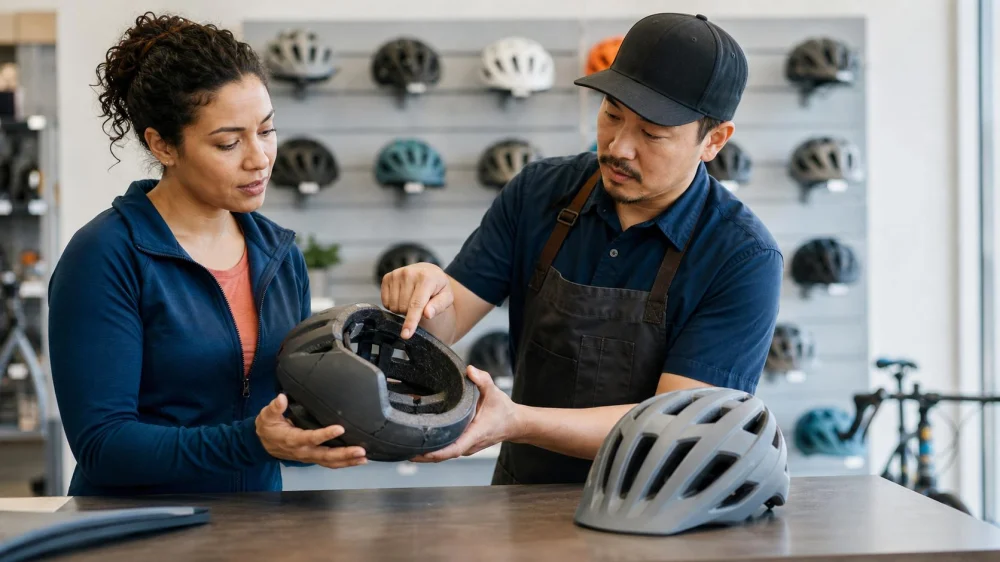
Bike Helmet Replacement: After Impact, Age, or Damage
On this page
Quick answer
Replace a bicycle helmet after a significant impact or crash according to its manufacturer's instructions, even when damage is not obvious. Also replace it for cracks, crushed foam, damaged straps or retention parts, chemical or heat exposure, poor fit, a recall, or the maker's stated service-life limit. Do not repair structural parts with glue, tape, paint, or improvised hardware.
This guide is for cyclists in the United States using typical single-impact bicycle helmets. Helmet design and instructions vary. A helmet reduces some injury risk but cannot prevent every head or brain injury.
When to replace now
A single-impact helmet is designed to manage energy partly by deforming or crushing internal material. That change can be difficult to see and is not reversible.
- Replace after a crash or hard impact when the manufacturer directs.
- Stop using a helmet with cracked shell, dented or crushed liner, separated layers, broken buckle, torn strap, or failed adjustment system.
- Replace when it no longer sits securely in the correct position or cannot be adjusted without pain or movement.
- Check current recall information using model and date details, and follow the stated remedy.
- Follow the maker's replacement interval and guidance for heat, solvents, paint, stickers, or other exposure.
After a crash involving head impact, confusion, loss of consciousness, worsening headache, repeated vomiting, seizure, weakness, unusual behavior, neck pain, or other concerning symptoms, seek urgent medical evaluation. Call 911 for an emergency and do not resume riding.
Pre-ride inspection
- Read the labels and manual. Identify the exact model, intended use, fit system, production information, and care limits.
- Inspect the exterior. Look for cracks, deep scratches, distortion, melted areas, and shell separation.
- Inspect the liner. Check visible foam for compression, cracking, missing material, or movement.
- Test retention parts. Examine straps, anchors, buckle, dividers, dial, and pads. Replace only user-serviceable parts approved for that model.
- Check fit. Position the helmet level and secure it following the maker's fitting sequence. It should not obstruct vision or shift excessively.
An inspection can find obvious problems but cannot prove that an impacted helmet is structurally sound. When impact history is unknown—such as with a used helmet—the safer choice is a new helmet with known history and instructions.
Care and fit checks
Store the helmet away from extreme heat, direct prolonged sunlight, heavy objects, fuel, solvents, and chemicals. Do not leave it where a vehicle interior may exceed the maker's temperature guidance. Clean only with approved methods and air-dry away from direct heat.
Recheck fit after hair style changes, growth, weight change, pad replacement, or adding cold-weather layers. Do not wear a cap, camera, light, mirror, or accessory under or on the helmet unless the manufacturer approves the configuration.
Important limitations
Appearance, price, certification label, and undamaged condition do not guarantee protection in every crash. Choose a helmet certified for its intended cycling use and market, correctly sized and worn on every ride. Specialized downhill, BMX, speed e-bike, or competition use may call for different standards or coverage.
Do not buy a used helmet when its crash, heat, chemical, alteration, or recall history cannot be verified. Never resell or donate an impacted or structurally damaged helmet as protective equipment.
Sources and evidence notes
This article reflects common manufacturer guidance, product-safety practice, and broad head-injury precautions. Exact replacement timing, inspection points, accessories, certification, and crash-discount programs are model-specific. Use the current manual, manufacturer support, recall database, and medical guidance.
Frequently asked questions
Can I keep using a helmet after dropping it?
Follow the maker's guidance and inspect it. A drop without an object inside differs from a crash, but visible damage or uncertainty deserves manufacturer review or replacement.
Can cracked foam be glued?
No. Adhesive does not restore the designed energy management and may damage materials.
Is an old helmet safe if it looks new?
Appearance alone is insufficient. Check the maker's service-life guidance, history, fit, parts, labels, recalls, and storage exposure.
Should a child reuse a sibling's helmet?
Only if history is known, the helmet is undamaged and within guidance, and it fits correctly. Never “grow into” a loose helmet.
Next steps
Photograph the helmet's model and date information, download its manual, inspect every structural and retention part, and check recall status. If it has been in a crash, shows damage, no longer fits, or has unknown history, retire it and select a correctly fitted replacement for the intended riding style.


 Big Peach Ride + Run - Brookhaven4.0 (146 reviews)
 Queen Village Bicycles4.0 (67 reviews)
 Trek Bicycle Oklahoma City4.0 (447 reviews)
 D&D Bicycles - Berkley4.0 (219 reviews)
 Krakatoa Bikes4.0 (44 reviews)
 Trail Sport Bicycles4.0 (202 reviews)
 How to Teach Kids to Ride a Bike: A Step-by-Step Guide for Parents
 Tips for Riding on Busy City Streets: Smart Strategies for Urban Cyclists
 Best US National Parks for Mountain Biking: Ride Epic Trails Across America
 Best Aero Helmets for Time Trials and Racing
 How to Clean and Lubricate Your Bike Chain Like a Pro
 10 Must-Have Items for Long-Distance Cycling Trips