
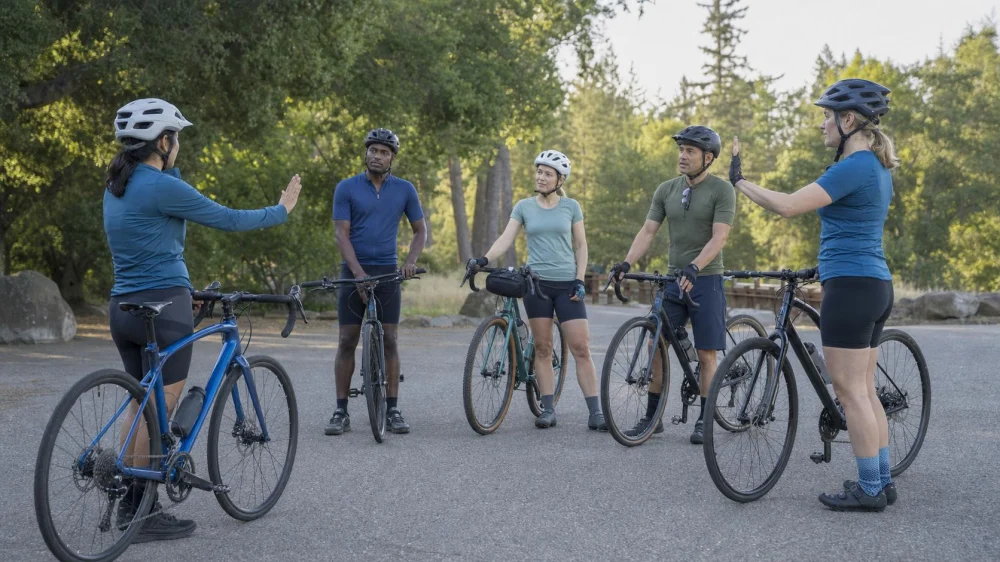
Group Bike Ride Communication: Calls, Spacing, and Stops
On this page
- Quick answer
- Agree on the system before the ride
- Communicate the core messages
- Use spacing that preserves options
- Handle junctions and turns individually
- Manage pace, position, and group changes
- Plan for mechanicals, separation, and emergencies
- Legal and safety limitations
- Frequently asked questions
- Sources and evidence notes
- Next steps
Quick answer
Before a group bike ride, agree on plain words and visible signals for slowing, stopping, turning, hazards, passing, and a rider dropping back. Repeat important messages through the group, ride predictably, and leave enough space to react. A signal is information—not permission to stop looking or to follow another rider blindly through a junction.
Group customs differ, and traffic law varies by state and locality in the United States. Follow the ride leader’s briefing only when it is consistent with applicable law and safe operation. Every rider remains responsible for scanning, yielding, signaling, and deciding when it is safe to proceed.
Agree on the system before the ride
A five-minute briefing can prevent twenty riders from attaching different meanings to the same shout. Ask the leader to cover:
- route type, expected pace, distance, climbing, and surface;
- single-file or paired formation expectations and when they change;
- the exact calls and gestures used for slowing, stopping, hazards, vehicles, and turns;
- whether the ride is no-drop, regrouping, drop, or pace-line training;
- planned rest, water, bathroom, and turnaround points;
- what happens when a rider has a mechanical problem or falls behind;
- leader, sweep, emergency contact, and route-sharing method;
- weather, darkness, construction, trail, or event-specific rules.
Tell the leader what matters
Say if this is your first group ride, first ride with that club, first time on the route, or first time at the advertised pace. Mention an access need or a communication limitation privately when useful. The leader can place you near an experienced rider, explain unfamiliar terms, or identify a shorter option.
Do not rely on phones for the basic system
A group chat and live location can help before or after a separation, but a rider should not read or type while moving. Spoken calls, lawful hand signals, positioning, and prearranged stops must work when batteries fail or coverage disappears.
Communicate the core messages
Use the group’s agreed wording, keep it short, and say it early enough for riders behind to react. Riders who receive a relevant call should repeat it down the line when safe. Avoid casual shouting that sounds like a warning.
Slowing and stopping
A sudden speed reduction can travel backward through a group like an accordion. Call “slowing” before braking when possible, then “stopping” for a full stop. Use the lawful or group-agreed gesture only if you can remove a hand without losing control. Brake progressively and hold your line.
Turning and changing lane position
Look behind, assess traffic, signal in advance, and move predictably when safe. Pass the turn message through the group, but each rider must confirm the maneuver. A leader’s arm signal does not guarantee that a driver has seen the last rider.
Road and trail hazards
Call or point to hazards that require a meaningful change: potholes, glass, debris, gravel, standing water, an opening car door, a narrowing lane, a low branch, or a trail obstacle. Identify the side or direction when useful. Do not stare at the hazard; look toward the safe path.
Signal only if doing so will not reduce your own control. A clear spoken warning may be safer when braking, cornering, descending, or riding on a rough surface.
Passing another rider or path user
Announce the side before overtaking, reduce speed, and allow room. A bell can supplement a voice where permitted, but neither guarantees the person heard or understood. Pass only when the path, law, and oncoming traffic allow. The whole group should not assume a gap remains open because the first rider passed.
Vehicles and other users
Some groups use “car back,” “vehicle behind,” or a local equivalent. Others use different terms. Agree before departure. Calls about horses, pedestrians, runners, dogs, farm equipment, or oncoming bicycles should be specific and calm. Reduce speed and follow the applicable passing rule.
Use spacing that preserves options
There is no universal number of feet that is safe in every group. Speed, visibility, weather, braking ability, surface, rider skill, and traffic change the space needed. The goal is enough time and room to respond without overlapping wheels, abrupt swerves, or contact.
Avoid wheel overlap
Do not place your front wheel beside the rear wheel of the rider ahead unless the formation and maneuver specifically call for side-by-side riding. A small lateral movement by the lead rider can touch the overlapping wheel and destabilize the following rider.
Look beyond the nearest wheel
Use peripheral vision for the rider ahead while scanning farther up the group and road. Early awareness of a signal, brake light, bend, surface change, or slowing pack gives more response time. Fixating on the tire immediately ahead hides the larger traffic picture.
Increase space when conditions worsen
Open the gap when descending, visibility is limited, pavement is wet, gravel is loose, the group is unfamiliar, traffic is complex, or riders are fatigued. Do not pressure someone to close a gap that they need for control. A social group is not automatically a racing pace line.
Hold a predictable line
Avoid abrupt sideways movement around a hazard. Signal or call it, reduce speed as appropriate, and move smoothly after checking the space. If you must make an emergency avoidance move, prioritize control and warn others as soon as possible.
Handle junctions and turns individually
At a stop sign, traffic signal, crossing, yield, or uncontrolled junction, each rider must comply with the law and decide whether the way is clear. Never follow a wheel through because someone ahead called “clear.” Their view, timing, and legal position differ from yours.
Do not wave the entire group through traffic
A motorist may yield politely, but riders should verify all directions and other lanes. A driver’s gesture cannot control approaching vehicles, cyclists, or pedestrians. Ride leaders should choose regroup points beyond the junction so separated riders do not rush.
Allow the group to split
A light can change or a gap can close between riders. The front group should continue only to the planned safe waiting point; the rear group should obey the signal and rejoin later. Avoid blocking a junction or encouraging someone to enter on a stale light.
Signal for road users, not only the group
Internal group gestures for potholes or formation changes do not replace legally required turn signals. Make intentions visible to drivers, pedestrians, and solo riders as well as companions. Check the current state driver handbook and local rules for approved signals.
Manage pace, position, and group changes
Starting and accelerating
Confirm that the group is ready, then increase pace gradually. A hard acceleration from a stop can split the line, especially when riders must clip in, navigate traffic, or restart on a hill. The leader should settle at the advertised pace only after the group clears the junction.
Rotating or moving within the group
Use the group’s stated rotation. Check beside and behind before leaving a line, signal or call the move, and change position smoothly. Do not surge while taking the front or drift backward without warning. Recreational rides may not rotate at all.
Changing formation
When moving from paired riding to single file, follow the leader’s specified method so two riders do not target the same gap. Maintain communication and create space instead of squeezing another rider. Applicable passing and lane-use laws control when a formation is permitted.
Leaving the ride
Tell the leader or sweep directly. Do not disappear at an intersection or assume someone noticed. Confirm whether you are riding home alone, meeting another person, or using a transport option. A brief message after you are safely stopped can close the loop.
When the pace is wrong
Tell the leader early rather than waiting until you are exhausted or far off the back. Use the advertised regroup or shortcut plan. If the ride is faster than described, prioritize a safe return over proving you can remain attached.
Plan for mechanicals, separation, and emergencies
Mechanical problem
Call “mechanical” or the agreed term, hold your line, and move off the travel lane only when safe. The riders behind pass the message. Do not stop the whole group in a blind bend, narrow shoulder, intersection, railroad crossing, or active trail line. Move to a safe location before inspecting the bike.
Rider off the back
The sweep communicates forward and applies the ride’s no-drop or regroup plan. The group should not reverse direction unpredictably in the roadway. Use a predetermined landmark or safe pull-off rather than bunching on a shoulder.
Lost contact
Stop in a safe place before using a phone. Check the route file, last known intersection, and agreed reunion process. Do not chase at unsafe speed. A rider who changes route should tell the leader once safely stationary.
Crash or medical emergency
Protect the scene without putting more riders in traffic. Call emergency services when needed, give the location and number of people involved, and follow dispatcher instructions. Do not move an injured person unless an immediate hazard requires it. Designate someone to warn approaching users from a safe position.
Group members should know who carries identification, first-aid supplies, repair tools, and emergency contact information. Those resources do not replace professional medical care or emergency response.
Legal and safety limitations
This article is general education, not legal advice. Bicycle signaling, lane position, lighting, helmet use, riding abreast, sidewalk use, yielding, and passing rules can differ across U.S. states and municipalities. Check the current state driver handbook, transportation agency guidance, event rules, and land-manager requirements.
NHTSA advises bicyclists to ride predictably, travel in the same direction as traffic, minimize blind spots, and signal and look over the shoulder before changing lane position or turning. Group communication supports these practices but does not override traffic control devices or individual judgment.
Do not remove a hand to signal when doing so would prevent control. Do not ride closer than your skill, equipment, or conditions support. A rider who cannot safely hold a line, brake, look behind, or signal should first practice in a traffic-free environment or take an on-bike class.
Frequently asked questions
Do I have to repeat every call?
Repeat important messages when the riders behind may not have heard them and you can do so safely. Avoid echoing unnecessary chatter. The group briefing should define which calls travel forward or backward.
What does “car back” mean?
Many U.S. groups use it for a vehicle approaching from behind, but terminology varies by group and country. Confirm the local vocabulary before departure instead of guessing.
Can I trust a rider who calls “clear” at a junction?
No. Treat it as information only. Look, comply with the traffic control, yield as required, and decide for yourself whether the junction is safe to enter.
How close should I ride to the wheel ahead?
There is no single safe gap for all conditions. Maintain enough room to respond smoothly, and increase it with speed, rain, low visibility, fatigue, rough surfaces, or unfamiliar riders. Avoid wheel overlap.
What if I cannot take a hand off the bar to signal?
Do not sacrifice control. Use a clear call when possible, slow or stop in a safe place, and practice one-handed control away from traffic with qualified instruction. Applicable law still matters.
Should a no-drop ride wait everywhere?
No-drop usually means the ride has a defined way to keep riders supported, not that the whole group stops in unsafe places. Ask where regrouping occurs and what the sweep does before starting.
Sources and evidence notes
- National Highway Traffic Safety Administration: Bicycle safety covers predictable riding, visibility, signaling, traffic direction, skill practice, and roadway responsibility in the United States.
- Cycling UK: Group-ride hand signals and calls explains how hazard and movement messages pass through a group and notes that customs differ.
- Cycling UK: How to lead a group cycle ride recommends explaining signals, waiting plans, traffic handling, and individual responsibility before departure.
The Cycling UK terminology reflects United Kingdom conventions and is included for group-communication principles, not as a statement of U.S. law. U.S. riders should verify local rules and vocabulary.
Next steps
Before your next group ride, ask for the route, pace policy, leader and sweep contacts, and the exact six messages used for slowing, stopping, turning, hazards, vehicles, and a mechanical. Save the regroup points, then practice predictable braking, looking behind, and lawful signaling in a traffic-free area.

 Dg Cycle Sports4.0 (49 reviews)
 Trek Bicycle Cambridge4.0 (201 reviews)
 Cyclone Cycles4.0 (93 reviews)
 Mike's Bikes of Folsom4.0 (212 reviews)
 LC TRI SHOP4.0 (122 reviews)
 Cycle Fast USA3.0 (147 reviews)
 How to Teach Kids to Ride a Bike: A Step-by-Step Guide for Parents
 Tips for Riding on Busy City Streets: Smart Strategies for Urban Cyclists
 Best US National Parks for Mountain Biking: Ride Epic Trails Across America
 Best Aero Helmets for Time Trials and Racing
 How to Clean and Lubricate Your Bike Chain Like a Pro
 10 Must-Have Items for Long-Distance Cycling Trips