
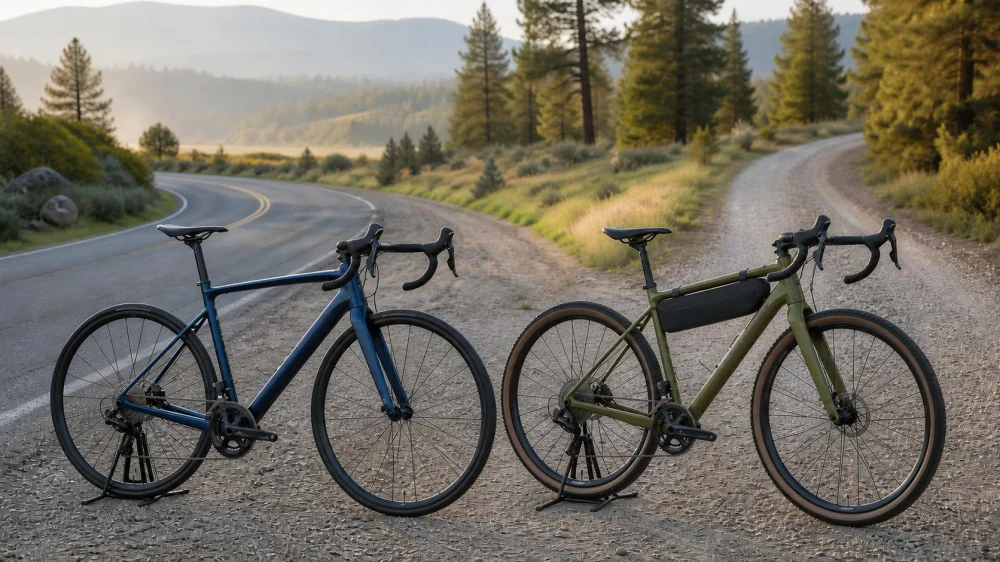
Gravel Bike vs. Road Bike: Match the Bike to Your Routes
On this page
- Quick answer
- The core difference
- Tires, clearance, and surfaces
- Geometry and handling
- Gearing and braking
- Mounts, cargo, and everyday utility
- Use a route-first decision test
- A practical test-ride checklist
- Limitations and safety notes
- Frequently asked questions
- Sources and evidence notes
- Conclusion and next steps
Quick answer
Choose a road bike when most rides use smooth pavement and you prioritize responsive handling, efficient road tires, and a road-focused riding position. Choose a gravel bike when routes include unpaved roads, broken pavement, wider tires, lower gearing, or extra cargo. The categories overlap, so compare the exact bike’s fit, tire clearance, gearing, mounts, and intended use—not its label alone.
This guide is for riders in the United States comparing drop-bar bicycles. Safe fit, component compatibility, terrain, skill, maintenance, and local access rules matter more than category names.
The core difference
A road bike is generally optimized for paved riding. Designs range from aggressive race bikes to upright endurance models, but they commonly emphasize road handling, lower aerodynamic resistance, and components selected for pavement.
A gravel bike is generally designed to cover paved and unpaved roads with wider tires, generous clearance, stable handling, and gearing suitable for loose or steep surfaces. Some are fast and race-focused; others prioritize bikepacking and utility.
An endurance road bike and a fast gravel bike can be very similar. Compare specifications and ride feel rather than assuming every gravel bike is slow or every road bike is uncomfortable.
Tires, clearance, and surfaces
Tire clearance is one of the most useful distinctions. Wider tires can run at pressures appropriate to rider, tire, rim, load, and surface, improving grip and comfort on rough ground. Tread pattern and casing also affect rolling feel, puncture resistance, and traction.
Road bikes may accept enough tire for rough pavement and maintained paths, while gravel bikes generally leave more room for mud and debris around a larger tire. The frame, fork, rim, brake, and manufacturer limits all constrain safe size.
Do not buy based on the printed tire width alone. Mounted width changes with the rim, and required clearance depends on conditions. Have a bike shop verify compatibility rather than fitting the largest tire that appears to squeeze in.
Geometry and handling
Many road bikes steer quickly and position the rider for sustained pavement speed. Endurance designs may use a taller front end and steadier handling. Gravel bikes often add stability for loose surfaces through wheelbase, steering geometry, and rider position, but designs vary.
Fit remains individual. A “relaxed” category does not guarantee comfort, and a race label does not establish the correct position. Reach to the controls, handlebar width and shape, saddle position, toe clearance, and weight distribution should suit the rider.
Best for technical loose descents: a bike whose handling, tires, brakes, and fit match the terrain and rider skill. Not ideal: selecting a bike for theoretical speed when its position prevents confident control.
Gearing and braking
Gravel bikes commonly offer low climbing gears for loose grades and loaded riding. Some use a single front chainring for simplicity; others use two for closer steps and broader road cadence choices. Road bikes also offer varied gearing, and an endurance setup may climb very well.
Compare the easiest gear, hardest useful gear, step size between gears, and component service needs. The number of chainrings alone does not define range.
Disc brakes are common in both categories. Rotor size, pad compound, tire grip, rider technique, load, weather, and maintenance affect braking. More powerful equipment cannot compensate for excessive speed or poor traction.
Mounts, cargo, and everyday utility
Gravel frames often include extra bottle, fender, rack, or bag mounts, but not every model supports every load. Road endurance bikes may include practical fender and rack provisions as well.
Before planning commuting or bikepacking, confirm:
- which mounts are structural and their load limits;
- heel, tire, brake, and steering clearance with bags installed;
- whether fenders fit with the chosen tires;
- how cargo changes handling and braking;
- which fasteners, racks, and adapters the manufacturer approves.
Use a route-first decision test
- List your real rides. Estimate how much is smooth pavement, damaged pavement, hardpack, loose gravel, or trail.
- Name the limiting surface. Identify the section where grip, clearance, gearing, or comfort currently fails.
- Define the group. Consider pace, stops, handling demands, and whether companions ride road or mixed-surface bikes.
- Include cargo and weather. Add commuting bags, bikepacking load, fenders, and seasonal surface changes.
- Choose the needed capability. Translate routes into tire clearance, gearing, mounts, and fit before comparing models.
If nearly every ride is paved and speed with a road group is the priority, a road bike may fit. If unpaved options are central—not merely hypothetical—a gravel bike’s extra capability may be worthwhile.
A practical test-ride checklist
- Confirm frame size and safe adjustment range with a qualified shop.
- Ride on representative legal surfaces when possible.
- Use every control from the hoods and drops.
- Start, stop, look behind, and signal without losing balance.
- Shift through low gears under an appropriate controlled load.
- Check low-speed steering, toe overlap, standing clearance, and brake modulation.
- Ask about included tire size, maximum approved size, tubeless compatibility, and service parts.
- Confirm warranty and permitted cargo, trainer, and accessory use.
Limitations and safety notes
A bicycle category does not grant access. Check land-manager rules, trail direction, seasonal closures, e-bike classifications, and private-property boundaries. Gravel roads may carry fast vehicles, dust, washboards, loose corners, and limited services.
Wear an appropriately fitted helmet, use visibility equipment for conditions, carry repair and communication options, and choose speed for sight distance and traction. Seek professional fit or medical guidance for persistent pain, numbness, or weakness.
Frequently asked questions
Can a gravel bike keep up on road rides?
It may, depending on rider, group pace, tires, gearing, position, and route. A fast gravel setup can work well on pavement, but it may feel different from a road-focused bike.
Can I put gravel tires on a road bike?
Only within the frame, fork, rim, brake, and manufacturer limits. Verify actual mounted width and safe clearance with a qualified shop.
Is a gravel bike better for a beginner?
Not automatically. Stable handling and wider tires may help on rough surfaces, but correct fit, manageable controls, route choice, and skills matter most.
Do I need two wheelsets?
No. Two compatible wheelsets can make surface changes convenient, but they add cost and require matching cassette, rotor, axle, and clearance setup. One suitable tire setup may be enough.
Sources and evidence notes
This comparison reflects broad bicycle design practice: tire clearance, geometry, gearing, braking, mounts, and fit shape a bike’s intended surfaces. Category boundaries overlap and model specifications change. Confirm current manufacturer limits and component compatibility before modifying a bike.
Conclusion and next steps
Map the routes you actually ride, identify the roughest recurring surface, and translate that need into tire clearance, gearing, fit, and cargo requirements. Test representative road and gravel models in the correct size. Choose the road bike when pavement performance dominates; choose the gravel bike when mixed-surface capability is a regular part of the plan.
 George Garner Cyclery Libertyville4.0 (219 reviews)
 Trek Bicycle Alamo5.0 (235 reviews)
 Hermosa Cyclery4.0 (213 reviews)
 The Meteor Bike Shop Austin5.0 (38 reviews)
 Northeast Cyclery LLC4.0 (87 reviews)
 North Portland Bike Works5.0 (115 reviews)
 How to Teach Kids to Ride a Bike: A Step-by-Step Guide for Parents
 Tips for Riding on Busy City Streets: Smart Strategies for Urban Cyclists
 Best US National Parks for Mountain Biking: Ride Epic Trails Across America
 Best Aero Helmets for Time Trials and Racing
 How to Clean and Lubricate Your Bike Chain Like a Pro
 10 Must-Have Items for Long-Distance Cycling Trips