
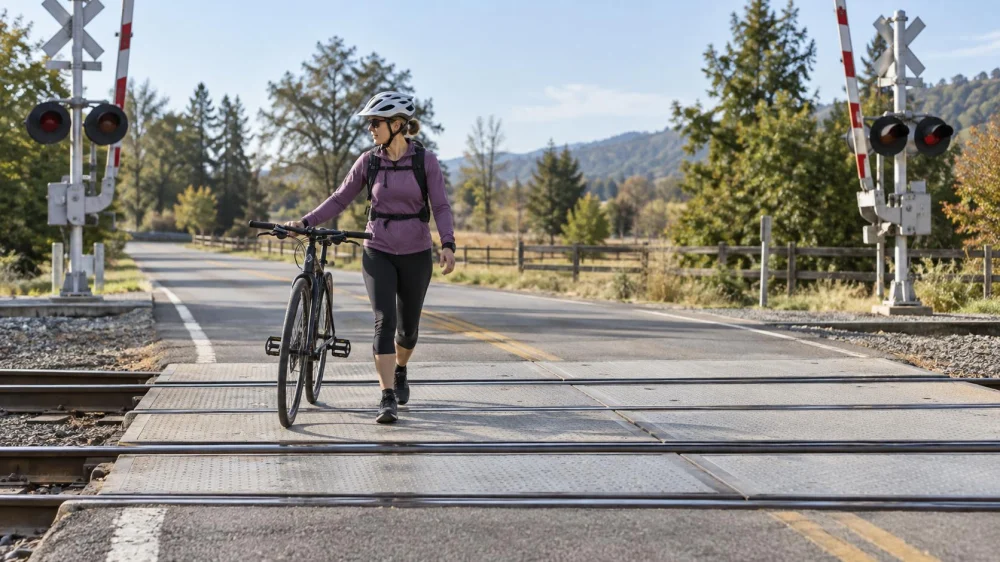
Bicycle Railroad Crossing: Angle, Rails, and Wet Weather
On this page
Quick answer
At a legal railroad crossing, slow before the rails, look and listen both ways, obey gates and signals, and cross as close to a 90-degree angle as the marked path safely allows. Keep the bicycle steady and avoid turning or braking hard on the rails. Dismount and walk when the angle, surface, traffic, or wet conditions make riding uncertain.
Approach and decide
Use only designated roadway or pathway crossings. Reduce speed early so you can evaluate tracks, flange gaps, surface height, traffic, and space beyond the crossing. Remove headphones and stop before the tracks when sight lines or warnings require it.
This guide applies to U.S. public crossings. Never ride along tracks or enter railroad property outside a designated crossing.
Cross near a right angle
A narrow bicycle tire can slip into the flangeway beside a rail, especially when the route crosses at a shallow angle. Federal guidance prefers a 90-degree crossing and identifies 60 degrees or more as a safer design range. Follow the designated path; do not swerve into traffic merely to improve the angle.
- Check behind before changing your line.
- Approach slowly with pedals level when practical.
- Cross the first rail with the front wheel nearly perpendicular.
- Hold a steady line across both rails.
- Resume normal position only after clearing the track area.
Obey every warning
Stop when lights flash, bells sound, gates move, or a train is visible or audible. Never go around a lowered gate or race a train. Wait until all tracks are clear, warnings stop, and the crossing fully opens; another train may approach from the opposite direction.
Leave at least the marked or instructed distance from tracks while waiting. Trains are wider than the rails and cannot stop quickly.
Wet and rough crossings
Metal rails, timber, rubber, paint, and debris can become slippery when wet. Brake and adjust speed before reaching them, keep the bicycle upright, and avoid sharp steering on the surface. Walk the bicycle when the approach is sharply skewed, slick, broken, or crowded.
If walking, step over rails rather than on them and keep wheels perpendicular to the flange gap.
If you fall or stall
Move yourself and the bicycle completely clear of all tracks immediately. Do not spend time collecting accessories in the track area. If a bicycle is trapped and a train may be approaching, leave it, move well away in the direction from which the train is coming, and call emergency services. Use posted crossing identification information if available.
Frequently asked questions
Should I bunny-hop the rails?
No. A controlled perpendicular crossing or dismount is more predictable for ordinary riders.
Can I cross when a gate starts rising?
Wait until warnings stop and the crossing is fully open, then check every track again.
What about streetcar tracks?
They create similar wheel-trapping and wet-surface risks. Cross near perpendicular when safely possible and follow traffic controls.
Should a group cross together?
Each rider must independently confirm it is safe. Never follow the group past an active warning.
Sources and evidence notes
The Federal Railroad Administration tells people with bicycles to cross only at designated crossings and at a 90-degree angle. The FRA's crossing alignment guidance explains how larger angles reduce wheel-trapping risk.
Next steps
Review your route for rail crossings before riding. At each one, slow early, remove distractions, obey every warning, and choose a perpendicular line only when it does not conflict with traffic. When conditions are uncertain, stop and walk across.
 Kirk's Bike Shop4.0 (189 reviews)
 Hardin's Bicycle Shop4.0 (61 reviews)
 Greenway 500 Bike Shop5.0 (66 reviews)
 Poynter Brothers Pro Bike and Skate Shop4.0 (75 reviews)
 Buckskin Bikes4.0 (115 reviews)
 STS Bicycles5.0 (2 reviews)
 How to Teach Kids to Ride a Bike: A Step-by-Step Guide for Parents
 Tips for Riding on Busy City Streets: Smart Strategies for Urban Cyclists
 Best US National Parks for Mountain Biking: Ride Epic Trails Across America
 Best Aero Helmets for Time Trials and Racing
 How to Clean and Lubricate Your Bike Chain Like a Pro
 10 Must-Have Items for Long-Distance Cycling Trips