
Bicycle Hand Signals: Look, Signal, and Change Position
On this page
Quick answer
Before turning or changing lane position on a bicycle, scan ahead, look over your shoulder, signal early enough to be understood, return your hand to the handlebar when control requires it, and move only after confirming the path is clear. A hand signal communicates intent; it does not create right-of-way or guarantee that drivers have seen you.
Basic signals
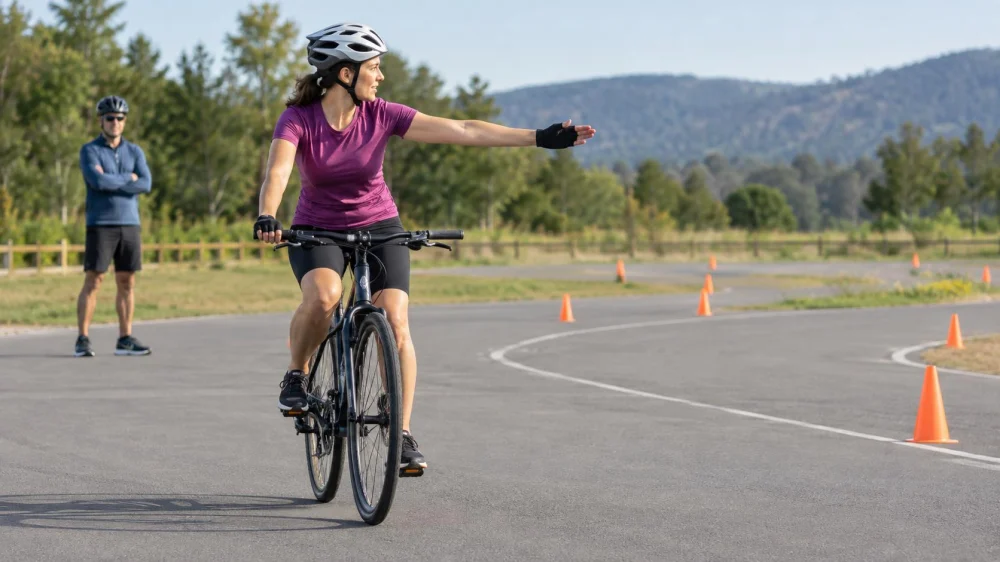
A common left-turn signal is the left arm extended straight out. A right turn may be signaled with the right arm extended straight out; some jurisdictions also recognize the left arm bent upward. A stop or slowing signal is commonly the left arm bent downward. State and local laws vary, so confirm the rules for the route.
This guide is for U.S. road riding. Children and newer riders should first practice balance, braking, scanning, and signaling in a traffic-free area with qualified supervision.
A safe sequence
- Identify the turn, merge, surface hazards, and traffic pattern early.
- Scan ahead and listen for traffic without using headphones that block awareness.
- Look over the shoulder while holding a straight line.
- Signal clearly without swerving.
- Return the hand when braking, steering, or rough pavement requires two-hand control.
- Check again and move predictably only when a safe gap exists.
At complex intersections, it may be safer to dismount and use a legal pedestrian crossing rather than make a difficult multi-lane merge.
Lane position
Ride where other road users expect to see traffic, in the same direction as vehicles. Avoid weaving between parked cars and the travel lane. Leave enough clearance from doors, debris, drains, and the road edge.
A very narrow lane may not allow safe side-by-side passing. Laws and recommended positioning vary, so use local bicycle guidance and choose lower-stress routes when possible. Signal and shoulder-check before any lateral move.
Practice off-road
- Ride a straight painted line while glancing behind.
- Extend each arm without drifting.
- Combine a shoulder check, signal, and controlled stop.
- Practice quick return to both brakes.
- Add a partner who calls out safe, closed-course prompts.
Stop the drill if balance or braking deteriorates. Professional bicycle education can help riders learn traffic positioning for local conditions.
Important limits
Visibility depends on lighting, contrast, angle, weather, and attention. Use legal lights and reflectors; do not assume a bright garment or signal has been noticed. Avoid sudden lane changes and never enter a gap solely because a driver appears to slow.
After a near miss, move to a safe location before reviewing the event or using a phone.
Frequently asked questions
How long should I signal?
Long enough to communicate, while keeping control. State law may specify timing or exceptions.
What if I need both hands to brake?
Finish the signal early and return both hands. Control takes priority when braking or steering.
Do signals give me priority?
No. They show intent. Yield and right-of-way rules still apply.
Can I signal from a bike path?
Yes when it helps others understand your movement, but follow path rules and use voice or a bell appropriately around pedestrians.
Sources and evidence notes
NHTSA bicycle safety guidance recommends predictable travel, signaling, and looking over the shoulder before changing position or turning. Its cycling skills guide describes basic left and right signals and closed-course practice.
Next steps
Check local signal rules, then practice shoulder checks and one-handed straight riding in a traffic-free space. On the road, plan early, signal clearly, confirm a safe gap, and choose a simpler crossing whenever traffic or balance makes the maneuver uncertain.

 Kirk's Bike Shop4.0 (189 reviews)
 Hardin's Bicycle Shop4.0 (61 reviews)
 Greenway 500 Bike Shop5.0 (66 reviews)
 Poynter Brothers Pro Bike and Skate Shop4.0 (75 reviews)
 Buckskin Bikes4.0 (115 reviews)
 STS Bicycles5.0 (2 reviews)
 How to Teach Kids to Ride a Bike: A Step-by-Step Guide for Parents
 Tips for Riding on Busy City Streets: Smart Strategies for Urban Cyclists
 Best US National Parks for Mountain Biking: Ride Epic Trails Across America
 Best Aero Helmets for Time Trials and Racing
 How to Clean and Lubricate Your Bike Chain Like a Pro
 10 Must-Have Items for Long-Distance Cycling Trips