
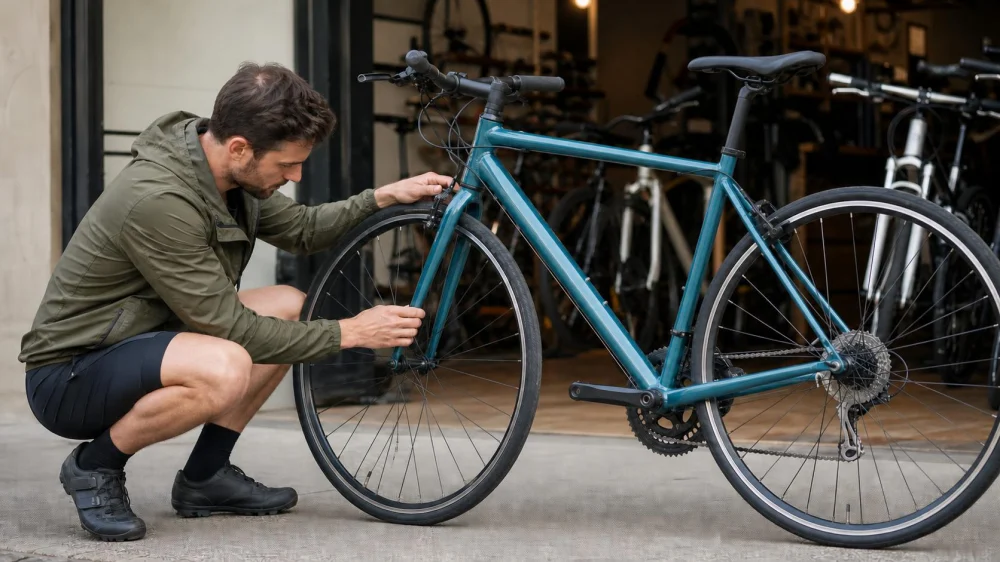
How to Test a Used Bicycle Before You Buy It
On this page
- Quick answer
- Start with fit and intended use
- Confirm identity and history
- Inspect the frame and fork
- Check wheels and tires
- Test brakes and drivetrain
- Check controls and bearings
- Use a structured test ride
- Repairable items and reasons to walk away
- Limitations and professional checks
- Frequently asked questions
- Evidence and practice notes
- Next steps
Quick answer
Before buying a used bicycle, confirm that it is the right type and approximate size, verify the seller and bicycle identity, inspect the frame and fork in strong light, then check wheels, tires, brakes, shifting, controls, and bearings. Take a permission-based test ride. Walk away from unclear ownership, suspected structural damage, unsafe operation, or a seller who blocks reasonable inspection.
Start with fit and intended use
A mechanically sound bicycle can still be a poor purchase if it does not fit or suit the route. Decide whether you need a bike for commuting, paved fitness rides, gravel, mountain trails, cargo, casual paths, or another specific use. Check the manufacturer's model and size information when it can be identified, but treat the label as a starting point rather than a complete fit.
With the bike stationary and supported, look for a workable range of saddle adjustment, comfortable reach to the handlebar, and adequate stand-over clearance for the bicycle type. Do not buy a clearly wrong size because a stem or saddle “might fix it.” Small contact-point changes can refine fit; they cannot correct every frame-size or geometry mismatch.
Before traveling to see the bike, ask for the model, approximate year, labeled size, current condition, included accessories, known damage, service history, and clear photographs of both sides. This filters obvious mismatches and creates a list of claims you can verify in person.
Confirm identity and history
Ask the seller how they obtained the bicycle and why they are selling it. Request any original receipt, service record, manual, or other ownership documentation they have. Locate the frame serial number—often under the bottom bracket or elsewhere specified by the manufacturer—and make sure it has not been deliberately removed, altered, or covered.
Check available local or national bicycle-registration resources and stolen-bike listings that are relevant in your part of the United States. A registry search cannot prove lawful ownership by itself, and the absence of a listing is not a guarantee. Compare the seller's identity and story with the listing, bicycle, documentation, and agreed payment record.
Do not proceed if the serial number appears tampered with, the seller refuses basic identity questions, the bicycle differs materially from the advertisement, or the transaction is being rushed in an unusual way. Use a safe meeting arrangement and preserve a written description of the bicycle and sale.
Inspect the frame and fork
Clean surfaces and strong, angled light make damage easier to see. Slowly examine the main tubes, welds or joints, fork legs, dropouts, bottom-bracket area, head tube, seat-tube junction, and mounting points. Look for cracks, ripples, dents, deep gouges, corrosion, separation, mismatched paint, or an alignment that appears twisted.
Paint chips and cosmetic scratches are not the same as structural damage, but they can hide it. Carbon fiber, aluminum, steel, and titanium show damage differently, and a photograph cannot reliably reveal every problem. Ask what caused a suspicious mark and whether a qualified shop has inspected or repaired it.
Turn the handlebar gently and check that the fork and front wheel move freely without a cable snag or obvious grinding. Stand in front of the bike and compare the wheel, fork, and frame centerlines. Do not attempt to straighten a fork, dropout, or frame during a viewing.
Check wheels and tires
- Spin each wheel and watch the rim relative to a fixed reference. Note large side-to-side or up-and-down movement.
- Confirm the wheels are fully seated and their axles or retention devices are complete and appropriate.
- Gently check for side play at each hub. Rough rotation, looseness, or noise needs evaluation.
- Look for broken, missing, unusually loose, or heavily corroded spokes.
- Inspect rim braking surfaces for damage or severe wear where applicable.
- Check tire tread, casing, sidewalls, beads, cuts, cracking, bulges, and correct seating.
A worn tire or a wheel that needs ordinary truing may be repairable, but the likely parts and labor belong in the purchase decision. A cracked rim, damaged hub, repeated spoke failure, or unclear wheel retention deserves a professional assessment before riding.
Test brakes and drivetrain
Squeeze each brake separately while the bike is stationary. The lever should move smoothly and leave enough travel to apply the brake without bottoming against the handlebar. Check that pads contact the intended braking surface, calipers move and release, rotors are secure, hoses or cables are routed safely, and there is no visible fluid leak.
With permission and a safe method of supporting or riding the bike, move through every gear. The chain should transfer without falling off, severe hesitation, repeated skipping, or the derailleur approaching the spokes. Inspect chainrings, cassette or freewheel, chain, derailleur, pedals, and crank arms for damage, looseness, heavy rust, or missing hardware.
A fresh adjustment cannot reverse worn parts. Chain, cassette, and chainring wear can interact, so replacing only one item may not solve skipping. Use visible condition and a shop estimate rather than accepting a promise that a complex symptom “just needs a tune-up.”
Check controls and bearings
Confirm the handlebar, stem, saddle, seatpost, brake levers, shifters, and grips are secure and adjustable without forcing them. The minimum-insertion marks on a seatpost or stem, if present, should not be exposed beyond their safe limit. Look for crushed tubes, rounded fasteners, seized adjustments, or improvised hardware.
Apply the front brake and gently rock the bike to detect obvious headset play, while recognizing that brake-pad movement can feel similar. Rotate the crank and wheels to listen for grinding. Hold each crank arm and pedal to check for unusual looseness. These checks can identify a concern, but they do not establish the exact cause.
If the bicycle has suspension, electric assistance, hydraulic systems, electronic shifting, an internally geared hub, or other specialized equipment, verify each mode and control. Ask for the correct charger, keys, firmware or app transfer process, and component documentation when relevant. Specialized systems may require model-specific diagnostics.
Use a structured test ride
Get the seller's permission, wear an appropriate helmet, and use a low-traffic area with a predictable surface. Confirm the brakes work at walking speed before increasing speed. A useful short test is deliberate rather than fast:
- Start and stop several times using both brakes progressively.
- Ride straight and notice whether the bike tracks predictably without an unusual pull.
- Shift one gear at a time through the practical range under light to moderate pedal pressure.
- Turn both directions at low speed and listen for rubbing, clicking, knocking, or grinding.
- Ride seated and briefly stand on the pedals only if the bike is safe and the situation allows it.
- Recheck for looseness, leaks, wheel movement, or new noises after stopping.
Do not use public roads, steep hills, high speed, jumps, or technical trails to test a bicycle of uncertain condition. If basic braking, steering, wheel security, or frame integrity is in doubt, skip the ride and arrange a shop inspection.
Repairable items and reasons to walk away
Consumables such as grips, ordinary brake pads, tires, tubes, cables, housing, a chain, or a saddle can often be replaced. Their condition still matters because several “small” items plus labor can change the total cost. Ask a bicycle shop for a written estimate when the purchase only makes sense within a firm budget.
Pause the purchase for any suspected crack, bent fork, significant corrosion, damaged wheel-retention area, failing brake, loose structural interface, incompatible modification, nonfunctional e-bike battery or electronics, or uncertain repair. Walk away when ownership is unclear, the seller will not allow a reasonable visual check, or pressure replaces answers.
The best used bicycle is not necessarily the cheapest listing. It is the bicycle that fits the rider and purpose, has a credible history, passes an appropriate inspection, and leaves enough budget for known service.
Limitations and professional checks
This checklist is a screening process, not a certification of safety or remaining service life. Hidden cracks, internal corrosion, crash damage, fatigued parts, battery degradation, and incorrect assembly can escape a basic viewing. Component wear limits and torque requirements are model-specific.
Use a qualified bicycle mechanic before purchase when the frame or fork is carbon, the bike has crash history, the asking price is substantial, the system is unfamiliar, or any structural, braking, steering, electrical, or suspension concern remains. Do not ride a bicycle that a competent inspection identifies as unsafe.
Frequently asked questions
Should I buy a used bicycle without a test ride?
Only if you understand the added risk and have another reliable inspection method. A test ride can reveal fit and operating problems, but it should not happen when the bike is visibly unsafe. A pre-purchase shop inspection is often more useful than guessing.
How much should I budget for repairs?
There is no universal amount. Parts, labor, bicycle type, local rates, and hidden damage vary. List each known issue and request current local estimates. Include essential accessories and fit changes in the total cost.
Are scratches on a used bike acceptable?
Some scratches are cosmetic, while others accompany impact or conceal damage. Inspect the location, depth, surrounding material, and seller's explanation. When the frame or fork may be affected, get a professional assessment rather than relying on appearance.
What should I check on a used e-bike?
In addition to the bicycle checks, verify battery identity and condition, charger compatibility, assist modes, display, error messages, keys, electrical connectors, software transfer, and available service support. Battery health and replacement compatibility may need brand-specific diagnostics.
Can a tune-up fix any shifting or braking problem?
No. Adjustment helps only when parts are compatible, serviceable, and not worn or damaged beyond their limits. Bent, cracked, leaking, severely worn, or incompatible components may require repair or replacement.
Evidence and practice notes
This article follows common bicycle pre-purchase and mechanic inspection practice: establish fit and use, verify identity, inspect structural parts before riding, test safety-critical systems at low speed, and escalate uncertainty to a qualified mechanic. Exact inspection points and service limits depend on the bicycle and component manufacturers.
No price, lifespan, repair guarantee, or claim of theft status is inferred from a visual check. Follow manufacturer guidance for component compatibility, wear limits, battery handling, fastener torque, and recalls where applicable.
Next steps
Save the listing, request the serial number and clear photos, and bring a small flashlight plus this checklist. Inspect in the order that protects your time: identity, fit, structure, wheels, brakes, drivetrain, controls, then test ride. Record every known repair before negotiating.
If the bicycle remains a candidate, ask a local bike shop in the United States whether it offers a pre-purchase inspection and what that inspection covers. Buy only after the bicycle, likely repair cost, and transaction history make sense together.
 Global Bikes & E-Bikes4.0 (651 reviews)
 Alpine Hut Bike Shop5.0 (1 reviews)
 Eddie's Bike Shop4.0 (223 reviews)
 Freeride Bike Co.4.0 (263 reviews)
 Atlantic eBikes4.0 (15 reviews)
 Allspeed Cyclery & Snow4.0 (693 reviews)
 How to Teach Kids to Ride a Bike: A Step-by-Step Guide for Parents
 Tips for Riding on Busy City Streets: Smart Strategies for Urban Cyclists
 Best US National Parks for Mountain Biking: Ride Epic Trails Across America
 Best Aero Helmets for Time Trials and Racing
 How to Clean and Lubricate Your Bike Chain Like a Pro
 10 Must-Have Items for Long-Distance Cycling Trips