
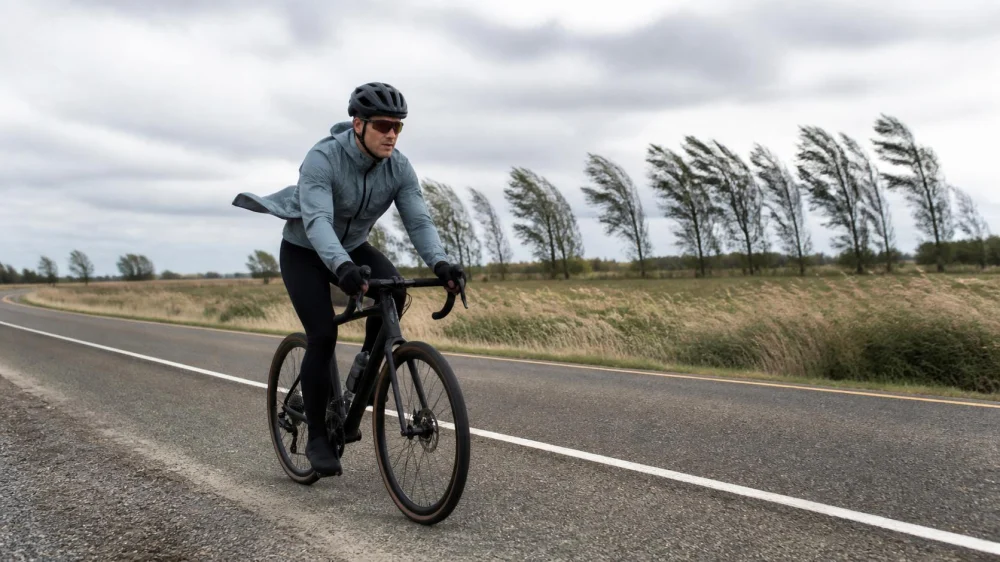
Cycling in Crosswinds: Position, Speed, and Route Choices
On this page
- Quick answer
- Why crosswinds deserve a plan
- Checks before the ride
- Use a stable riding position
- Manage speed and road position
- Expect sudden gust zones
- Choose and revise the route
- Equipment considerations
- Crosswinds in a group
- When to stop or turn back
- Limitations and important notes
- Frequently asked questions
- Evidence and practice notes
- Next steps
Quick answer
In a crosswind, reduce speed before exposed sections, keep both hands securely on the handlebar, relax your elbows, and leave extra lateral space for gust-driven movement. Watch trees, grass, flags, dust, and other riders for changes. Expect abrupt wind near gaps, bridges, buildings, and passing large vehicles. Choose a sheltered route, and turn back when you cannot hold a predictable line.
Why crosswinds deserve a plan
A cycling crosswind is wind moving substantially across a rider's direction of travel rather than mainly from ahead or behind. It can create continuous side pressure or a sudden steering disturbance. The challenge is not merely extra effort: changing wind can move the bicycle laterally, alter balance, and reduce the space available between the rider, traffic, curbs, shoulders, debris, or other cyclists.
Wind rarely behaves uniformly along an entire route. Trees, hills, buildings, underpasses, cuttings, and walls can shelter a rider, then expose them within a few feet. A steady lean that feels manageable in the open may become the wrong correction when the wind is briefly blocked. Gusts also vary in direction and strength.
This guidance is for ordinary road, path, gravel, and commuting situations. It is not a forecast threshold, racing tactic, or promise that a particular wind is safe. Rider skill, body size, bicycle, load, surface, traffic, visibility, and gust pattern all change the decision.
Checks before the ride
- Read the full forecast. Look beyond average wind speed. Check gusts, direction, timing, storm advisories, temperature, precipitation, and whether conditions are expected to worsen before your return.
- Map exposed segments. Identify bridges, open farmland, waterfronts, ridgelines, broad intersections, and roads with fast traffic or narrow shoulders.
- Choose bailout points. Know where you can shorten the loop, turn toward shelter, stop indoors, or arrange transport without committing to a long exposed stretch.
- Inspect the bicycle. Confirm wheel retention, tire condition and pressure, steering, brakes, luggage security, and any fairing or accessory that could catch wind.
- Secure clothing and cargo. Close loose jacket panels and straps. Balance loads and prevent bags, covers, or dangling items from shifting.
- Set a decision boundary. Agree with yourself or the group that inability to maintain line, repeated dangerous movement, or deteriorating weather means stopping or rerouting.
Wind direction relative to the route changes at every turn. A manageable headwind on the outward leg can become a difficult crosswind or tail-crosswind later, especially if fatigue has increased. Plan the entire ride rather than judging conditions only at the start.
Use a stable riding position
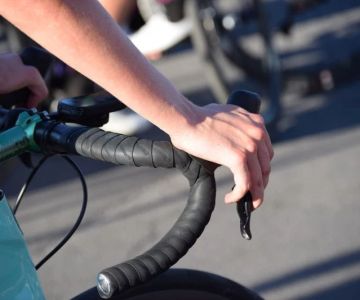
Keep both hands in a secure position that gives immediate access to steering and brakes. Use a firm, controlled grip without locking the elbows or squeezing so hard that small corrections become abrupt. Support your upper body with a balanced posture rather than placing excessive weight through the hands.
Look well ahead toward the path you intend to follow. A distant visual reference helps reveal lateral drift earlier than staring at the front wheel. Keep pedaling smoothly when appropriate; sudden force changes, abrupt steering, or an unnecessary out-of-saddle effort can make the bicycle harder to manage during a gust.
Do not copy a fixed lean angle. Make small corrections based on the actual wind and roadway, recognizing that the required pressure changes when shelter begins or ends. If your correction must become large, continuous, or unpredictable, the conditions may be beyond a sensible riding limit.
Manage speed and road position
Reduce speed before entering an exposed area, not after the first severe gust. A lower, controlled speed can provide more time to observe changes and respond without a sharp maneuver. Brake progressively while the bicycle is upright and traction is reliable; avoid grabbing a brake in the middle of a sudden steering correction.
Leave usable space on the downwind side where conditions and traffic laws permit. Avoid riding so close to a curb, edge drop, barrier, parked vehicle, or another cyclist that one lateral movement removes every option. At the same time, do not drift unpredictably into a traffic lane. Signal and scan before any intentional position change.
The safest legal road position varies by location and circumstance in the United States. A painted bike lane may still contain debris or offer little buffer, while a shoulder may end without warning. Follow applicable laws and choose a visible, predictable line that accounts for current hazards.
Expect sudden gust zones
Prepare for a wind change at:
- the end of a hedge, tree line, wall, or row of buildings;
- gaps between structures and openings in terrain;
- bridge entrances, exits, and exposed spans;
- intersections that create wind channels;
- the crest of a hill or transition out of a cutting;
- the approach and departure of buses, trucks, trailers, and other large vehicles;
- open shorelines, fields, and elevated roads.
A large vehicle can first disturb the air and then briefly block the crosswind; the wind may return sharply after it passes. Keep both hands ready, avoid an unnecessary overcorrection, and create as much lawful separation as possible. If the roadway offers no workable buffer, stop in a safe place and reconsider the route.
Choose and revise the route
A good crosswind route reduces exposure and consequence. Prefer lower-speed roads, protected paths where open and suitable, routes with predictable shelter, and segments that provide safe stopping options. Avoid combining strong side wind with narrow bridges, high-speed traffic, poor surfaces, darkness, or a steep drop at the edge.
Shelter is not always safer. Dense urban streets can produce sudden wind channels at intersections, while wooded routes may contain falling branches during severe conditions. Review official weather and facility alerts, closures, construction, and known debris reports where available.
Use a short loop near home to test conditions before committing to a remote route. If a section feels marginal on the outward trip, it may be worse after a turn or weather change. Rerouting early is usually simpler than waiting until the most exposed point.
Equipment considerations
Wheel rim depth, bicycle geometry, luggage, rider position, and accessory shape can affect how side wind feels. Deeper-section wheels and broad surfaces may respond more noticeably to gusts, but the exact behavior depends on the wheel, bicycle, rider, and wind angle. Use manufacturer guidance and experienced professional advice for equipment-specific decisions.
Keep panniers or bikepacking bags balanced and firmly attached. Remove unnecessary loose covers, oversized empty bags, or accessories that move in the wind. A child seat, trailer, cargo load, aerodynamic fairing, or high-sided load changes the system enough to require a more conservative decision.
Do not lower tire pressure simply because it is windy. Choose pressure for the tire, rim, load, surface, and manufacturer limits. Wind planning does not override correct wheel, tire, brake, or steering maintenance.
Crosswinds in a group
Increase lateral and following space so one rider's movement does not cause contact. Keep calls short and specific: “gust,” “debris,” “slowing,” or “stopping” is more useful than a long explanation while the group is moving. Pass warnings along the line.
Advanced formations used by trained cycling groups may involve staggered positions, but they can consume road width and may be inappropriate or unlawful on public roads. Do not improvise an echelon with an inexperienced group. Prioritize predictable single or paired positioning that fits the road, traffic rules, and leader's plan.
Regroup in a genuinely sheltered, off-road location. Do not stop in a travel lane, at the exposed end of a bridge, or where the wind can push a stationary rider into traffic.
When to stop or turn back
End or pause the ride when you repeatedly cross your intended line, cannot keep both hands securely controlling the bicycle, must lean or steer unpredictably, or cannot leave adequate space from traffic and fixed hazards. Also stop for falling debris, dangerous dust, lightning, rapidly worsening weather, impaired visibility, or an official warning affecting the route.
Choose a stopping location before dismounting: a parking area, side road, building, or other space away from traffic and falling branches. In a severe gust, walking an exposed bicycle can also be unstable. If necessary, wait in suitable shelter or arrange transport rather than assuming walking is automatically safe.
Limitations and important notes
No single wind-speed number can determine whether every rider should continue. Forecast sensors may be far from the route, local gusts can exceed general conditions, and units or reporting intervals can be misunderstood. Combine current observations with official forecasts and conservative judgment.
New riders, children, riders using adaptive cycles, people towing trailers, and riders with high or shifting cargo may need wider safety margins and individual instruction. General cycling advice does not replace local traffic rules, emergency alerts, medical guidance, or supervised skills training.
Frequently asked questions
Should I lean into a crosswind?
A rider may naturally apply small steering or body corrections, but a fixed lean is not a universal technique because gusts and shelter change. Keep corrections smooth and remain able to respond when the wind suddenly reduces or reverses.
Are deeper bicycle wheels unsafe in wind?
They can feel more affected by side wind, but response varies with wheel design, bicycle, rider, load, and conditions. Follow the wheel manufacturer's guidance and test unfamiliar equipment conservatively in controlled conditions.
Is a tailwind always helpful?
No. A tail-crosswind can still move the bicycle sideways, encourage excess speed, and make turning or stopping harder than expected. Treat wind by its actual direction and gusts on each segment.
What should I do when a truck passes?
Maintain a predictable line, keep both hands ready, and expect changing air pressure as the vehicle approaches, passes, and clears. Avoid sudden steering. Where the road and law permit, create space before the encounter; otherwise stop safely and choose another route.
Can I walk the bike if riding feels unsafe?
Sometimes, but first choose a safe place to dismount. A bicycle can catch wind while being walked, and roadside exposure may remain dangerous. Seek suitable shelter or transport if walking does not reduce the hazard.
Evidence and practice notes
This article reflects common cycling instruction and broad safety practice: anticipate exposure, preserve control, increase space, reduce speed before hazards, secure equipment, and use clear stop criteria. Wind behavior is highly local, and equipment response is model-specific.
No forecast threshold, crash-risk percentage, or equipment guarantee is asserted. Consult official weather services, road authorities, land managers, event organizers, and manufacturers for current conditions and product-specific limits.
Next steps
Before the next windy ride, mark exposed segments and two bailout options on your route. Secure clothing and cargo, inspect the bicycle, and test conditions on a short familiar loop. While riding, use three cues: look ahead, keep space, and slow before exposure.
If crosswinds routinely shape your routes in the United States, ask a qualified local cycling instructor or bike shop about skills practice and equipment suited to your rider profile. Local knowledge can identify bridge, canyon, shoreline, or open-road wind patterns that a general guide cannot.
 Global Bikes & E-Bikes4.0 (651 reviews)
 Alpine Hut Bike Shop5.0 (1 reviews)
 Eddie's Bike Shop4.0 (223 reviews)
 Freeride Bike Co.4.0 (263 reviews)
 Atlantic eBikes4.0 (15 reviews)
 Allspeed Cyclery & Snow4.0 (693 reviews)
 How to Teach Kids to Ride a Bike: A Step-by-Step Guide for Parents
 Tips for Riding on Busy City Streets: Smart Strategies for Urban Cyclists
 Best US National Parks for Mountain Biking: Ride Epic Trails Across America
 Best Aero Helmets for Time Trials and Racing
 How to Clean and Lubricate Your Bike Chain Like a Pro
 10 Must-Have Items for Long-Distance Cycling Trips