
Bicycle Helmet Replacement: Damage, Fit, and Age Checks
On this page
Quick answer
Replace a bicycle helmet after a crash or impact when the manufacturer directs, even if damage is not obvious. Also stop using it when the shell, impact liner, straps, buckle, adjuster, or fit is damaged or unreliable. Check the model instructions for service life and care. A replacement should meet current requirements for your market, fit securely, and stay level during a movement test.
Replace after an impact when directed
A bicycle helmet manages impact through materials that may compress, crack, separate, or deform. Some changes can be hidden by the outer shell or comfort padding. A visual check alone cannot prove that an impacted helmet retains its designed protection.
After a crash, record what happened and follow the instructions for the exact brand and model. When the helmet or a helmeted head struck the ground, a vehicle, a tree, another rider, or another hard object, stop using it until the replacement decision is clear. Do not conduct a second impact test at home.
Seek medical evaluation when the rider may have a head, neck, or other injury. Helmet replacement and medical assessment are separate decisions; a rider can need care even when the helmet looks normal, and a damaged helmet may need replacement even when the rider feels well.
Inspect the shell, liner, and attachments
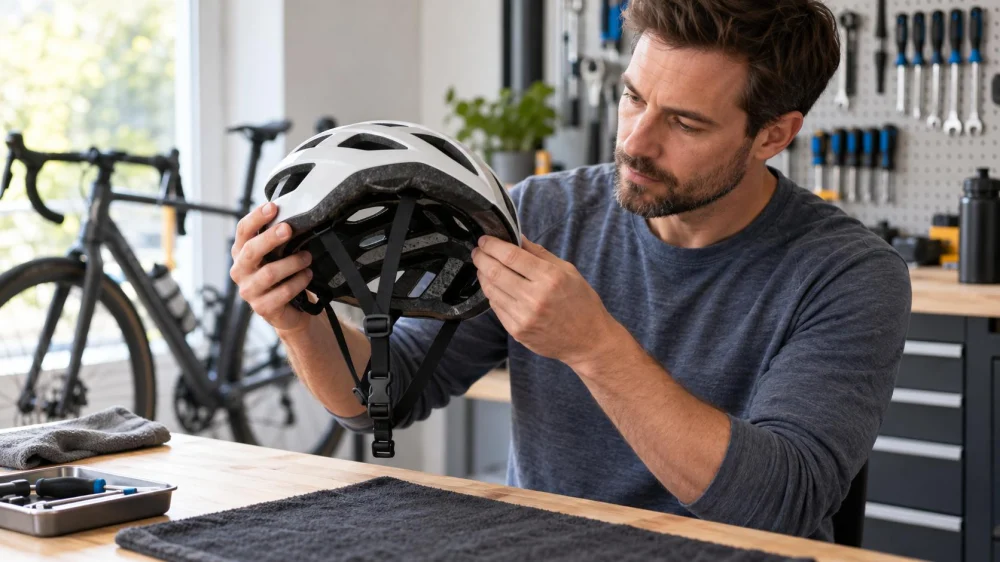
Use bright light and clean, dry hands. Remove only pads that the instructions say are removable. Compare both sides and look for a change rather than expecting one universal failure pattern.
- Check the outer shell for cracks, deep gouges, dents, bubbling, distortion, or separation from the liner.
- Inspect visible impact foam for cracks, crushing, missing pieces, soft spots, or permanent deformation.
- Follow every strap path and look for cuts, pulled stitching, heat damage, chemical damage, or severe fraying.
- Close the buckle and operate the retention dial or slider; it should engage consistently without slipping.
- Check anchors, visor mounts, accessory points, and pads for looseness that affects fit or structure.
- Look for damage caused by a heavy object, closing vehicle door, fall from height, pet chewing, or another non-riding event.
Do not glue a cracked shell, fill damaged foam, sew a structural strap, or replace a buckle with an unapproved part. Contact the manufacturer when a component is replaceable or the significance of a mark is uncertain.
Check whether the helmet still fits
A helmet can become unsuitable without a crash if the retention system no longer holds adjustment, padding changes substantially, or the rider grows or changes hairstyle. Use the model instructions, then test with the rider in a normal upright position.
- Place the helmet level rather than tilted far back or forward.
- Adjust the internal retention system so the helmet is secure without painful pressure.
- Arrange side straps according to the instructions and remove twists.
- Fasten the chin buckle and set the permitted clearance.
- Shake the head gently and move the helmet by hand; it should not expose a large new area or slide into the eyes.
- Check vision, hearing, and compatibility with ordinary eyewear.
Pressure pain, numbness, repeated loosening, a buckle that opens unexpectedly, or a helmet that cannot sit level are reasons to stop and reassess. Do not use a thick hat, aftermarket pad, camera mount, or other accessory unless the helmet maker permits it.
Use age, storage, and care as decision inputs
Time alone does not reveal the condition of every helmet, and replacement intervals vary. Find the manufacture date or model information and read the current maker guidance. Heat, ultraviolet exposure, chemicals, repeated drops, heavy compression, and poor storage can shorten useful life.
Store the helmet where it will not be crushed and away from high heat, direct sunlight, fuel, solvents, and cleaning chemicals. A closed vehicle can become very hot. Clean only with the products and method listed by the manufacturer, and let padding dry fully before storage.
Keep a simple record of purchase date, impacts, replacement parts, and unusual exposure. When the history of a used helmet is unknown, hidden impact or improper storage cannot be ruled out; a new helmet with known history is the clearer choice.
Choose and set up the replacement
Look for a helmet intended for cycling that complies with current requirements applicable in the United States and any rules for the event or facility. Verify the label and seller rather than relying on appearance or an unsupported marketplace claim.
Try more than one size or shape when possible. The best option is the one that can be adjusted level and secure across the whole head without isolated pressure. Higher price, more vents, or lighter weight does not compensate for poor fit.
Transfer only accessories the new manufacturer allows. Lights, mirrors, cameras, visors, and adhesive mounts can affect fit or create concentrated loads. After setup, repeat the fit test and read the care and replacement instructions. Keep the receipt and model information in case a recall or support question arises.
Frequently asked questions
Must a helmet be replaced after every drop?
Not every low drop has the same effect, but inspect it and follow the model guidance. Replace it when a rider's head was inside during a significant impact or when damage or history is uncertain.
Can I keep riding when only the visor is broken?
Check whether the visor and mount are structural or replaceable for that model. Remove or replace parts only as the manufacturer directs, and confirm the remaining helmet fits correctly.
Can damaged helmet foam be repaired?
Do not glue, fill, or reshape the impact liner. Contact the manufacturer or replace the helmet when impact material is cracked, crushed, separated, or otherwise damaged.
Is a secondhand helmet safe?
An unknown crash and storage history makes evaluation difficult. Verify full history, model, age, labels, fit, and condition; when those cannot be confirmed, choose a helmet with known history.
Where should I verify replacement guidance?
Use the current manual and support information for the exact helmet model, plus applicable cycling laws, event rules, and recognized safety requirements for your market.
Conclusion and next steps
Check impact history first, then inspect the shell, liner, straps, buckle, adjuster, and fit. Use the exact manufacturer guidance for replacement interval, care, parts, and accessories. When an impact, defect, unreliable fit, or unknown history leaves meaningful doubt, retire the helmet and select a properly fitting replacement before the next ride.

 Trek Bicycle East Northport5.0 (521 reviews)
 NW Ambush Extreme Sports4.0 (149 reviews)
 GC Performance Coaching4.0 (5 reviews)
 OC Bikes E-bikes Sales, Service and RENTAL4.0 (15 reviews)
 Garrison's Cyclery4.0 (201 reviews)
 Pete's Bicycle Shop4.0 (107 reviews)
 How to Teach Kids to Ride a Bike: A Step-by-Step Guide for Parents
 Tips for Riding on Busy City Streets: Smart Strategies for Urban Cyclists
 Best US National Parks for Mountain Biking: Ride Epic Trails Across America
 Best Aero Helmets for Time Trials and Racing
 How to Clean and Lubricate Your Bike Chain Like a Pro
 10 Must-Have Items for Long-Distance Cycling Trips